Leave a comment

History Trumps A Royal Flush

HISTORY TRUMPS A ROYAL FLUSH

BUCK WILD 1972 HONDA 400 (2)

“The best woman I ever had, I won in a card game. Not in New Orleans, Vegas or some other “City of Sin”, but in Dayton, Ohio. My prize was an even less likely result given I had not played poker since the sixth grade.”

By Don Kenton Henry

The best woman I ever had, I won in a card game. Not in New Orleans, Vegas or some other “City of Sin”, but in Dayton, Ohio. My prize was an even less likely result given I had not played poker since the sixth grade.

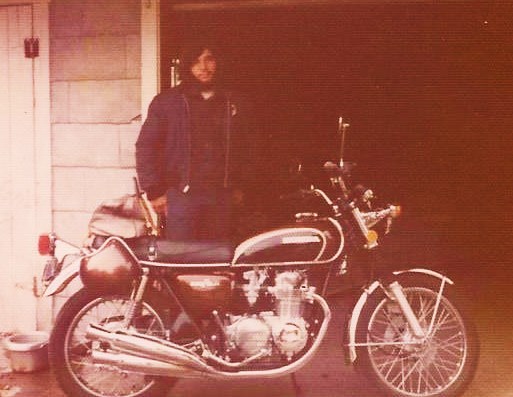
The year was 1973 and I was on my way back to Indiana University on my Honda 400 motorcycle after a road trip to the Rock and Roll Hall of Fame in Cleveland. A broken chain got my bike and I a ride to a chopper shop in east Dayton. While waiting on a replacement, the shop experienced a boom in business as 12 members from the Sons of Sedition biker gang rode in on their choppers.

While the gang waited on parts of their own, a game of standard poker broke out on the engine block of a Chevy V8 on the shop floor. I was asked to join. Correction–I was told to join. In spite of my best efforts to lose what little cash I had, my hand continued to play hot until everyone folded but a guy they called . . . “The Cannibal”. And I had most of his money. I tried not look at the New Zealand aboriginal tattoos covering his face or his filed eye teeth and attempted to avoid eye contact. I tried to fold myself but a twenty pound hand from behind came to rest on my shoulder and convinced me I would not. Cannibal raised the stakes and put his bitch in the pot. “This is Heather. We call her ‘Header’. She is worth all that cash you got in your purse and then some, kid.”

“But this is all I have”, I said. “Put it in, kid” he said. I discarded and asked the dealer to hit me. I felt the blood run out of my head as my hand went “flush”. I turned the corner up on the Jack of Spades. With the Ace, King, Queen and 10 of Spades I already held, this gave me a Royal Flush. An unbeatable hand. The bike chain arrived and Header climbed onto the back of my Honda and we headed out on I-70 toward Indy into the setting sun. I stopped to let her off at an IHOP on the edge of town but Header, still seated behind me on the Honda, took me by my ears. As she pulled me back against her firm and ample breasts, I could feel her nipples through her tie-dyed tank top which bore the white dove on a guitar neck concert logo and the words, “Woodstock Came to Me”. She put her lips against my right ear and said, “Kid . . . I got no kin within 300 miles–and if you leave me here The Cannibal will track you down and eat you with his chorizo.” This she punctuated with a flick of her studded tongue in my ear canal. I dropped the bike from neutral into first gear and gunned it toward that great red ball.

I awakened to the smell of eggs and bacon and found Header cooking in the kitchen with my mother. We were at my mom’s house in Tipton, Indiana where I had taken us the night before. It was about halfway back to my university. Unbelievably, my uptight Presbyterian mother (history buff that she was) was totally taken with the tattoo of an adulteration of the Monroe Doctrine, signed by The Cannibal, which began at the nape of Header’s neck and extended south beyond the northern border of her bell bottom jeans. It was something of a proclamation to the effect that Cannibal retained a sovereign right to wage war against any party he perceived posed a threat to his interest in the property bearing said proclamation. Specifically–Header.

She was a big hit back at college, especially with my brothers at the SAE house. Header and I didn’t come out of my room the first three days she was there. We locked my roommate out and lived on nothing but Noble Roman’s pepperoni pizza with anchovies which we ordered by phone and had the delivery boy slip through the door. By that third day, the entire hallway reeked of anchovies and sex. (I know –you’re thinking that’s redundant.) On the eve of the fourth day, my “roomie”, in an act of desperation, pulled a fire alarm. We still refused to vacate the room until a fireman threatened to break the door down with a pick axe. Reluctantly, we entered the hallway, Header wearing nothing but her Woodstock tank top.

I got extra credit after presenting her as “show and tell” in my American History class after which she disappeared for a three-day weekend with my history professor. (This may or may not explain how I managed to pull an A out of a solid C- average at semester’s end.)

She became increasingly popular with my fraternity brothers to the point I succeeded in getting a vote passed to make Header an “Honorary Little Sister”. This ultimately had to be reversed when word got out to the sororities and every “official” little sister threatened to terminate her status with our house.

Then–during one night of freshman rush–we floated a keg which Header rolled into the hot tub and, topless, rode like a bucking bull waiving one arm above her head while singing our school fight song.

I awakened the next morning to the guttural “ka-chunk” of a Harley hawg and the low growl of its pipes. I watched from the window of my room as it pulled away from the frat house with Header on the back. Header glanced over her shoulder and gave a small wave. The Cannibal, without looking back or missing a gear, gave me the one finger salute. I turned and saw the words, “Woodstock Came to Me” draped on the headboard of my waterbed. I guess you can’t stand in the way of true love–and the Monroe Doctrine trumps even a Royal Flush.

The rest of my college career was relatively uneventful. I graduated and married a cute little blonde Tri Delt. Her name is Susan. We call her “Suzie”. She shops.

Occasionally, when I am riding my BMW touring bike through the hills of southern Indiana, I am passed by a group of bikers in bandanas and leather. It’s been thirty years since I saw her and I still check the back of each bike for Header. To no avail.

I have a foot locker I purchased from an army surplus store and have dragged with me since my college days. It has a sticker on its lid from the Rock and Roll Hall of Fame. Every once in awhile I unlock the padlock and pull an old tank top from the bottom. I bury my face in it and feel my nostrils flare. I don’t know the chemical formula for pepperoni and pheromones but I know every time I eat pizza with anchovies . . . I get aroused. Susie knows this but doesn’t understand why. She just keeps taking me to Noble Romans every time she is feeling a little amorous.

← Back

Thank you for your response. ✨

Leave a comment

Tragekitty

TRAGEKITTY
“A classic case of trag-i-dip-i-ty: the occurrence and development of events by chance with tragic or CATastrophic consequences.”

CAT WITH BOMB 1
By Don Kenton Henry

It is rare two seemingly unrelated incidents in time come together at precisely the same place such that the lives of all involved – or in this case the lives–and–death of one – become inextricably entwined and forever changed. But on Halloween in the year of nineteen hundred and sixty-nine, not two but four incidents, each of which should have had no relation to each other, coincided in such a way that forty three years later some cannot yet speak of what came to pass. And Halloween each year, some cannot help but doing so. It is this tale true I tell to you. A classic case of trag-i-dip-i-ty: the occurrence and development of events by chance with tragic or catastrophic consequences. As a tribute to Rod Serling, I ask for your indulgence.
Bull and I decided this, our fifteenth pagan holiday, would be the time to pull off the greatest prank since Dr. Frankenstein created the monster. And apparently it was the Doctor who inspired us for the plan began with a mission to obtain a fresh road kill from the back country roads outside our small town of Finn’s Landing, Indiana. It went on to involve a burglar alarm my brother had purchased from an army surplus store. The alarm worked on the same principle as a hand grenade with a pin which, when detached, caused the alarm to emit an ear piercing screeching sound which could be heard two or three city blocks away. The plot was to freeze the road kill in a standing position then surgically insert the alarm into the abdomen of the animal. This incision would be stitched tight but a string would hang attached to the pin in the alarm now inside the creature. The final phase of the plan was to put the mechanically altered cadaver on the front porch of some hapless victim, activate the alarm by pulling the string thus removing the pin and leave them to process how such an aberration of nature could have managed to visit them this holiday.
Our morbid scavenger hunt began the eve before. We enlisted the help of Little Schuler who, a year older than us, had his driver’s license and a huge, white 1963 Plymouth which bore a striking resemblance to Moby Dick. A raccoon is what we had in mind as we climbed into “The Dick” and began to scour the county roads. What could be more fitting then a furry trick or treater already sporting a mask? On any other occasion, the roads would have been littered with countless creatures of the night which had a particularly difficult time crossing the road. But this afternoon was the exception. We searched almost three hours to no avail. It was almost as though the highway department was one step ahead of us clearing the roads of carcasses and thus spoiling our plan. Finally, as dusk set in and the shade of the trees over the road began to blend with the night, Bull said, “Dang, Henry–it looks like this is one scheme of yours is one that isn’t going to happen. At least not in time for Halloween.”
“Yeah,” said Little Schuler. “It looks like you’re going to have to kill something if you want to make this happen.”
“I was thinking the same thing myself,” I said. “But now I think I have a better idea.”
“Uh, oh,” said Schuler. “When Henry gets a better idea – things usually get worse!”
“Head back into town and turn east on Main Street,” I instructed him.
Schuler did so and we proceeded to that end of town. “What do you have in mind, Henry?” asked Bull.
“Dr. Bird, our family veterinarian has his office three blocks up. When we get to it, I want Little Schuler to pull the car behind the office. When my cousin worked for him as an assistant, she told me they always take the animals they put down that day out to a separate dumpster behind the office and the city picks them up each morning and takes them to the county landfill. All we have to do is reach in that dumpster and “voila'” we got our dead dog or whatever to work with. It won’t be quite the same as having a screaming raccoon on your doorstep but a very high pitched poodle would be pretty cool, don’t you think?”
“Henry is a genius,” said Bull.
“Yeah, a regular Leonardo DaVinci!” laughed Schuler as he pulled into the alley behind Dr. Bird’s office. I got out and asked Schuler to open the trunk of his car while I approached the first dumpster. He did then came up behind me. I opened the lid and peered inside. It appeared to be filled with nothing more than trash bags full of paper and used supplies. No dead pets. I moved to the second dumpster, red in color, with the words City Property painted on it. I opened the lid and peered in. Little Schuler could not do the same because … well – because he’s little – so he asked, “What a’ ya see in there, Henry?”
“Well – we got two choices. We can go with a Saint Bernard or we got an orange tabby cat. What do you think?”
“I think it will take Bull to get a Saint Bernard out of there and how are you ever going to get it into your mother’s deep freeze!”
“You are right about that, for sure!” I answered. But the sight of a frozen St. Bernard on their porch would make quite an impression!” I laughed. Still – it would take days to freeze him even if I could keep my mom from getting any frozen waffles out of the freezer.” With that I climbed over the edge and into the dumpster. The cat, an old female, was a little stiff, but not terribly so. They must have put her down at the end of the day. I handed her over to Bull who had exited the car by now. He took and threw the kitty in the trunk and said, “Let’s get the heck out of here.”
Once back at my house I got a box from the garage, we put the tabby in it and I carried it into the house and down into the basement where my mother kept her bronze upright Amana deep freeze full of the aforementioned waffles, pot pies, tv dinners and fudge sickles with which she fed her four kids as she tried to earn a living as a single mother. We went past it to my bedroom which had formerly been McNamara’s Irish Tavern before we owned the house. It was the main reason my father, and Irish drunk if ever there was one, had wanted the house. Now that my parents divorced, I asked mom if I could move my bed in there next to the pool table. She said, “Sure, honey, if that will make you happy.” It did and had instantly made me the most popular kid in the freshman class. I slept in the glow of flashing Pabst Blue Ribbon and Falstaff beer signs along with statues of Johnny Walker Red and Kentucky racehorses lining the ledge along the walls.
We set the box down on the pool table and I told the guys I would be back in a minute. I went upstairs and grabbed last Sunday’s edition of The Indianapolis Star. Once back with Bull and Little Schuler, I removed the cat from the box and lay him on the financial pages which I had spread on pool table. “She’s getting stiffer by the minute. Pretty soon, I won’t even be able to work with her,” I said. I then took the newspaper and rolled it into a big, fat roll and tied it with some string I had also grabbed on my way back down. I placed the roll of paper in the middle of the bottom of the box running length wise. It was a perfect fit with the ends of the roll wedging themselves up against the ends of the box. Next, I picked the cat up and placed it on the roll, straddling it with two legs on either side. I made certain to bend all her paws and place them on the floor of the box so she would freeze in a perfect standing position. The cat was just a little too long for the box and I had to pull her chin up and rest it against the end of the box. This meant she would freeze with her head posed as though she were looking up at a forty five degree angle. Her tail was hanging out and over the edge of the other end of the box and I took it and bent it over and wrestled it under the flap at that end then closed the other three, took some duct tape and taped the box shut. As it was mid evening by now, I thought it safe to take the cat to mom’s deep freeze and deposit her for the evening. There was a key to the freezer on a nail on the wall behind the freezer and after burying the cat under a pile of pop tart and ding dong boxes, I closed and locked it. The plan was to let her freeze all night then get her out in the morning before my mom opened it to prepare for breakfast . I would then take her into the bar and place her in a smaller freezer inside a refrigerator there. The key to the deep freeze would remain with me until then.
I then explained the rest of the plan to Bull and Little Schuler. “Ok, guys. I will get the cat out of the freezer early in the morning and move her into the one in my room. You guys be over here right after school tomorrow.” Tomorrow would be Halloween and a Friday. “By then ,” I continued, “the cat should be frozen but not entirely. We will implant the burglar alarm in the cat and place her back in the freezer to really make her hard and frigid. You guys can leave then but be back a little before dark when we’ll load her in the car and go out to find our victim.”
“Whose porch are we going to put her on, Henry?” said Bull, a look of boyish glee on his face.
“I don’t know yet. I haven’t thought that far ahead. But you guys think about it. Think about some teacher or someone you hate enough to do this to. ”
“Wow, this is going to be so cool, Henry!” This will be cooler than when we hand-cuffed Mary Ann Atkinson to the tray at the “Dog N’ Suds” when she brought us our Black Cows and Coney dogs!”
“Oh yeah, this will be way bigger than that!” laughed, Bull, literally jumping off the floor with delight. “But who do we hate that much? This is going to be tough!”
They left and I went upstairs and watched Bewitched and Dragnet on TV before bed. I returned to my bedroom and pondered what a great Halloween awaited as I fell asleep to the flashing red recessed lights in the ceiling and the almost lullaby quality of “Hey Jude ” on the 78 rpm album by The Beatles.
My alarm (not the one for burglars or cats) went off as planned at 6 a.m. By now, kitty had been on ice for approximately ten hours. I did not bother to inspect her as I moved her from one freezer to the other. In approximately nine hours, Bull and Little Schuler would return and we would proceed with the next phase of our plot. In the meantime I went back upstairs for some of those frozen waffles before school. My little brothers and sister ate with me, oblivious to the macabre plot which was unfolding in the inner sanctum, which was my Irish tavern bedroom, beneath them.
Almost on cue, I heard Bull and Schuler pounding on the back door of my home opening to the stairs leading to my basement and bedroom. I went to let them in and, to my surprise, it was not only Bull and Schuler waiting to enter, but “Reidy Bones”, Mark Comerford, the Maverick twins and “Finko”. Word gets around in a small town and it seems every teenage boy that got wind of this wanted to witness the unveiling and surgical enhancement of our frozen feline friend.
I led the seven others down and into the room where they gathered around the pool table and took seats on the scotch guarded floral fold out sofa bed and one of several bean bag chairs. The pool would become the surgery table and I had prepared it in advance with the burglar alarm, sewing needle and thread, a ball of white kite string, scissors, a pair of kitchen tongs and my mother’s GE electric kitchen knife. This was the same knife that, less than a month later, my grandfather would use to carve the Thanksgiving turkey. It and the other items were spread out in an orderly fashion on another edition of the Indianapolis Star. The guys were laughing in nervous anticipation until I spoke up and asked Little Schuler to serve as my surgical nurse and assist me in the operation. He agreed and rose to stand at the table beside me. I went to the door of the bedroom and locked it to make certain neither my mother or one of my siblings barged into the less than sterile environment of the operating room. I then went to the refrigerator and opened the door. Next I opened the freezer compartment where I had barely managed to wedge the box containing the cat and pulled it out. I turned and carefully carried and placed it on the pool table behind me. The boys leaned forward in their seats as I began to remove the duct tape from the lid of the box.
No one knew what to expect. The orange tabby had gone in as someone’s recently deceased pet but other than the obvious lack of animation had no particular characteristics to distinguish it from living house cats. As I raised the lid, one flap at a time, the boys rose and gathered at my and Little Schuler’s backs. “Oh my god, what in the hell is that!” exclaimed Schuler. We all caught our breath as we peered over the edge and into the box. After regaining my composure, I reached in and carefully grasped under the sides of the cat and slowly pulled her off the newspaper roll, extricated her from the box and placed her on the papers spread on the green felt of the table. I pushed the box aside to give full view and an opportunity to appreciate my creation thus far.
What had gone in as an old but otherwise, cute tabby cat whose head one could have easily imagined themselves stroking as they smoked their pipe, sipped their tea or enjoyed the Ed Sullivan Show, now bore more resemblance to some poor creature which had somehow survived a nuclear holocaust or was the genetically mutated result of such. It looked like one of the monsters in the Japanese horror shows which came on at midnight except that this one was three dimensional and in color standing in the middle of the pool table.
“Holy shit! That’s one ugly fucking cat!” said the Maverick brothers as one.
“If I saw that on my porch, I would sure run like hell!” said Finko. “Get as far away from that fucking thing as fast as I could!
Of what were once two beautiful green eyes, the right was now frozen shut. The left was frozen wide open but covered with a deep frost making it white as the cue ball in the corner. It’s left ear was frozen so flat against the top of its head, it was imperceptible. On the other side the right one stood straight in the air as though perked to hear what was next in store for its owner on reprieve from a junk yard grave. Of the four paws, three remained steadfast to the surface beneath them. But the left front leg had somehow retracted in the freezing process was raised as though pawing the air in front or attacking some invisible adversary. Say another cat or some horrified homeowner for example. But it was the tail . . . the tail that defied imagination and provided the coup de grace to my excellent invention. After having been wrestled and contorted in the process of manipulating it into the box, it now was frozen, rising straight into the air for a quarter of its length. When observing the cat head on, its tail next took a ninety degree turn to the right for another quarter, then a ninety degree straight up again before taking a ninety degree turn to the left. In essence, it formed a perfect question mark which is exactly what you thought when you saw it. Specifically – “what in the hell is that!”
After ample time for admiration had been had by all, and an abundance of effusive accolades heaped upon me for my artistic genius, I announced the surgery would begin.
“Schuler, while I prepare to make the incision in the cat, you cut off and tie about a twelve inch piece of string to the pin of the alarm.”
As he did so, I turned the cat over on its side with its belly facing me. I inserted the chrome knife blades into the electric knife and plugged it into the extension cord I had running under the pool table. I pressed the trigger on the knife and the blades quickly slid into motion ready to prepare a holiday dish like none before. I asked Schuler to hold the front paws still as I raised the top rear leg to provide me full access to the abdomen, started the knife and began to make a length wise incision which would ultimately run from about half way down from its neck to its groin. I proceeded managing only to run it about a quarter inch deep due to the frozen constituency of the cat. I made a second pass which took it another quarter inch down or so. At this point I came to realize if I were ever going to get the alarm hidden entirely within, I would need to plunge the knife at least four inches in cut a path the same in length. To do this, I turned the cat on its back and with the knife whirring away forced it hard into the belly. I pierced it inch or two when the knife suddenly broke through to unfrozen material, followed by the emission of some of what remained of what was obviously kitty’s last meal. This was accompanied by the foulest odor I encountered before or since. Schuler and I gagged simultaneously and everyone in the room began spewing expletives. It was then I knew instantly why surgeons ask you and your animals to fast before surgery. But imagine if the patient has had Fancy Feast Tuna Delight putrefying in its large intestine for a least two days–a portion of which while lying in the bottom of dumpster with a Saint Bernard.
After several of us went through an odd dance of heaving, waiving arms and spinning to some tune unheard to all but bearing no resemblance to “Hey Jude”, I attempted to proceed with the surgery but could not succeed in disengaging my gag reflex. So I called a recess and everyone backed into a corner of the room while I went upstairs. I soon returned with two red bandanas and a can of lilac air freshener I requisitioned from the back of a toilet seat. I instructed Schuler to spray the air fresher directly at the cat while I proceeded with the surgery. Enveloped in the fog of the air freshener which created the ambiance of a sewage treatment plant in the middle of a field of lilacs–all too insufficiently filtered by the bandana–I managed to create an orifice of large enough to allow insertion of the alarm. I had installed fresh batteries and quick test of it produced a loud screech which had the result of the guys instantly placing their hands over their ears confirming its functionality for this mission.
Once inserted with the string hanging out, I took needle and thread and stitched the cat at least as tight as a Wilson football. Having done so, I turned the cat upright in a standing position and stood back to admire my work.
“Excellent job, Henry!” said Bull. It’s beautiful! We have to give her a name. She needs a name!”
Everyone immediately agreed and as we continued to admire her offered all the predictable clichés, most of them names of cartoon characters. In the end, that’s what we settled on. Felix – a cartoon cat popular on television in the fifties and sixties.
“But Felix was a tom cat and this cat is a female!” objected Bull.
Little Schuler, who suggested the name in the first place, countered, “That’s a technicality! Can you think of a famous female cat?” None of us could so the name stuck.
“Yeah … well by any name she’s gonna really going to scare the shit out of someone!” I said with no absence of pride.
Then Mark Comerford asked the “sixty thousand dollar question”. “So whose porch are you going to put it on, Henry?”
I answered, “I still don’t know. I’ve been so concerned with getting the cat ready I haven’t given it much thought. Have you and Schuler thought of anyone?” I asked Bull.
“All I can think of is “Dog Ears”, our school principal whose ears appeared cropped like a Doberman Pincher’s, or “The Blond Bomber”, our history teacher, Mr. Rossi, who dyed his long thick hair platinum blond and combed it straight back over his head before shellacking it with so much hair spray spit balls just bounced off it.
Everyone said something to the effect that they agreed those were rather worthy options and I said, “Well – that will do for a start. We’ll think about it some more while I put the cat back in the freezer and let it set up until this evening when trick or treaters start to hit the streets.”
With that I put the frozen feline back in the Frigidaire and the rest of the guys departed up the stairs and out of the house laughing as they went.
(TAKE NOTE, DEAR FRIEND. THAT WAS THE SECOND OF FOUR INCIDENTS INEXPLICABLY LINKED IN TIME AND SPACE THAT HALLOWEEN OF 1969 I SUBMIT FOR YOUR CONSIDERATION.)
That night, about an hour before dark, Little Schuler and Bull arrived in “The Dick” which they pulled into the alley next to the back door to the basement. I told Bull to get in the back seat and deposited the cold cat cargo, still in its box between us. Schuler exited the alley headed east down Sycamore Street, our ultimate destination still uncertain.
“Ok, guys–it looks like we are thinking of Dog Ears or Rossi, is that right?” I said this as I removed the duct tape from the lid of the box and removed Felix. I threw the box in the front seat next to Shuler and stood our frozen companion on the seat between myself and Bull. Bull immediately began to stroke her head. “Don’t pet the cat, Bull! You’ll make her thaw out too soon! Look! The frost on her eye is already starting to melt!”
“Geeze–she’s hard as a rock! I think it’s going to be awhile before she melts!” Bull replied.
Little Schuler spoke up from the front seat, “I sure would love to see Dog Ear’s face when he sees this! But the “Blond Bomber” is such a priss – he’d probably have a heart attack. It’s a tough call!”
“Well I know where The Bomber lives, but do you guys know where Dog Ears lives?” I asked.
“Nope.” They both answered.
“If we are going to put it on his porch we better get a phone book and look his address up,” I said. “Go to the phone booth by the fire station.”
It was just around the corner. Schuler parked and I got out and went into the booth. A few seconds later I got back into the car shaking my head. “No such luck. His number is unlisted.”
“Well that’s probably a good move on his part,” said Schuler. “He probably got tired of having his house egged and grocery bags full of dog poop lit on fire on his porch!”
“Yeah . . . so I guess it’s ‘The Blond Bomber’,” I said.
Everything and everyone was just a few short minutes away in Finn’s Landing and “The Bomber” lived two streets north and just a few blocks west so in no time we were cruising slowly by his house.
“All his lights are off. It doesn’t look like anyone is home,” Schuler said. “The curtains are open in his living room but it’s dark inside.
“Maybe he’s playing not a home,” I said. “Maybe he’s tired of the eggs and the dog poop too! Pull in the alley behind his house and we’ll check his garage and see if his car is in there.”
We did. I got out and peered in the window of his garage. Felix patiently waited on the seat but was now moist to the touch. I steadied her as I slid back in next to her. “Nope. His car is gone. He must be staying at his mother’s house wherever she lives. You know what a momma’s boy he is. ”
At this point, Bull shouted out, “Hey, how bout Missy Bumbauer? She lives right next to ‘The Bomber’ and the lights are on in her place!”
” Missy Bumbauer!” exclaimed Schuler. “What do you have against Missy Bumbauer?”
“She broke up with me about six months ago.”
“You mean you want to torment her because she had the good sense to break up with you!” I laughed as Schuler drove out the alley and around the block while we gave it some thought.
“Yeah . . . and because she’s a real bitch!” Bull continued, pressing his case. “Besides she is so uptight and proper and all that. I would just love to see her when she sees Felix. They’ll probably hear her scream clear across town!” As he did we passed her house slowly and the three of us checked it out. It looked like everyone was home and preparing for trick treaters a few of which were beginning to make their way down the sidewalks. A five foot witch of the scarecrow variety was on the porch with a lit Jack O’ Lantern next to her. Two women were in the kitchen and Mr. Bumbauer was in full view through the full length glass of the storm door. The wooden front door was fully opened behind it. He was seated in his leather recliner with his feet resting on an ottoman.
Now Mr. Bumbauer had the distinction of being an Indiana State Senator and had been for the past twenty years or more. Like many of his kind he had a reputation of having a penchant for women and scotch which even as kids we, along with everyone else in town, had heard of. He constantly won reelection through his support of farm subsidies including a federal program which paid farmers for an experiment conducted by Purdue University in conjunction with the Department of Agriculture. Its purpose was to determine whether classical music played round the clock in barns increased the birth weight of pigs.
“Yeah, Missy Bumbauer would be pretty cool!” agreed Little Schuler.
“Well, I guess that settles it. Bumbauer it is! Now drive down the street for a minute while we get the plan straight. Schuler – I want you to go turn around and come back west by her house so that my side door opens facing her front porch. I am going to jump out, run to her porch and put Felix right next the pumpkin looking up at the front door. I’ll set off the alarm, jump over the side rail of the porch and run through the alley next to the house and come out on the other side of the block. I want you to drive like blank around the block and – when I come out – I want Bull to have my car door open so I can jump right in so we can get the blank out here! You got it?”
“Got it!” they said in unison.
We had turned around and slowly approached the house. I pulled Felix onto my lap and grasped the handle of the car door with my right. “Now remember!” I reminded Schuler, “Pull right around the block and get me!”
He quietly pulled the car to a stop and I jumped out, carrying Felix like that Wilson football as I jumped three steps and landed on the front porch. A quick glance and I could see the Hogan’s Heroes on the television. Senator Frushour was engrossed in the newspaper with a tumbler of scotch in his hand which rested on the armrest of his recliner. He did not even look up and was apparently going to let Becky and her mother greet all the trick or treaters. I set the cat down staring straight up through the glass of the front door and pulled the string. The alarm went off as planned and, even from inside Felix, its scream was deafening. With one hand on the porch rail, I cleared it and ran down the alley to the back side of the block. As I exited, I saw “The Dick” fly around the corner almost on two wheels as it sped toward me. It never came to a full stop as, on cue, Bull opened the passenger side door and I jumped in, my face almost landing in his lap. I sat up, and pulled the door shut as we sped east away from the crime scene. As I got my breath I joined in with Bull and Schuler laughing hysterically.
“Boy, can you imagine Missy’s face when she sees that cat!” said Bull.
“Yeah, and I bet Senator Bumbauer drops his scotch right out of his hand,” I replied. “Let’s give it a few minutes, but we have to drive back buy so we can see what they are doing”
We drove around downtown which was just a few blocks north for about five minutes before heading back toward Missy’s. “You know there’s going to be a huge crowd in front of the house. Everyone who lives in the neighborhood is going to come out of the house. All of the Olsons, the Bunnells, the Blacks, the Schnerples will be trying to get a look. We probably won’t even be able to get the car through the crowd,” said Schuler.
As we got closer to the house, we grew silent. The windows were down and we could hear the alarm still wailing, its new batteries holding up nicely. But to our utter dismay there was no one in the streets. In fact, as we slowly drove by, there was no one on the porch. The streets were conspicuously absent of any sign of life, including trick or treaters. It looked like a ghost town. Once again, we drove around the block, our speed now down to that of a slow crawl as we expressed our disbelief. We tried to peer back through the alley toward the Bumbauer’s but it was now dark and we could not see a thing.
“What the hell!” said Bull. “Why aren’t they out there checking it out. The front door is still open and there is no one even in the living room! Who wouldn’t be out there looking at something like that!”
I was just staring ahead, struggling for an explanation. “I don’t get it. No one is in the street. No one is on their porch. It just doesn’t make sense!” Two more passes in our car confirmed this was still the case before I finally said, “Well . . . I guess you might as well drop me off at my house. I suppose we’ll hear something about this from Missy when we get to school on Monday.
(TAKE NOTE, DEAR FRIEND. THAT WAS THE THIRD OF FOUR INCIDENTS INEXPLICABLY LINKED IN TIME AND SPACE THAT HALLOWEEN OF 1969 I SUBMIT FOR YOUR CONSIDERATION.)
“The Dick” dropped me off in front of my house and no sooner had the car door slammed than my little sister, just eight years old, came running from the house. “Donnie! Donnie!” she screamed, tears streaming down her chubby face, “Tell me it isn’t true! Tell me you didn’t do it!” she pleaded. Kenton is my middle name. Donnie is what everyone called me whenever I was in trouble. They called me that a lot.
“Do it? Do what, Sis?” I didn’t have to feign I was incredulous. Was she referring to the cat? How could they possibly know?
“The police are on the phone with mom right now! They say you put a bomb on Senator Bumbauer’s porch inside a dead cat and it is going to go off any moment and blow his house up! Tell me you didn’t do it!” she continued, clinging with her arms around my waist as I made my way into the house.
“A bomb! I didn’t do it! I promise, Sis!”
I walked into the house as my mother set the phone down on the receiver. She looked up almost expressionless and said, “The police are at the Senator’s house. They cannot figure out how to disarm the bomb you put in the cat and they want you to go there and stop it before it explodes. They have patrol cars out looking for you right now.”
“Mom, I didn’t do it …” I began.
She instantly held her hand up in traffic cop fashion instructing me to stop. “That was Mr. Fink I just got off the phone with. He is going to accompany you to the Bumbauer’s.”
I could see there was no point in lying all together or even in trying to explain it was a burglar alarm and not a bomb for now. I went out the door and over, to Mr. Fink’s (Finko’s dad) house.
Mr. Fink was on his porch when I arrived and as I started to walk up his steps I attempted to explain. He must have attended the same traffic school as my mother for he immediately presented the hand gesture to stop. I hung my head as he came down the steps and together we headed down to the middle of the block and cut through the alley where we saw a huge crowd gathered at its end. The Bumbauer’s lived just one street over and the alley came out almost directly across the street from their house. The street where there was no one a half hour earlier there were now dozens, fifty or more people including all nine of the Olson kids and the Schnerples lined the sidewalk opposite the Bumbauer’s. They had all come running when they heard the emergency vehicle sirens. Mr. Fink and I had to push our way through the crowd. “There he is, that’s him! Kenton Henry, you’re a freak!” yelled Missy angrily pointing her finger at me. Senator Bumbauer, had a obviously finished his scotch, perhaps the entire bottle, and was off to the side telling anyone who would listen that this was probably some plot to thwart his reelection campaign. I didn’t know it at the time, but Mrs. Bumbauer was in the back of the fire engine emergency vehicle that was first on the scene. She was being treated for a rapid heartbeat before eventually being taken to the hospital and sedated.
“I don’t know, but he could be a ‘Young Republican’!” I heard the Senator him rant as we made our way toward the porch. It was an already surreal event which became more so by the moment. Standing safely back, a uniformed police officer kept the crowd out the street, while another in fully padded, white bomb detonating protective gear–replete with a helmet and facemask–stood on the steps of the porch with an instruction manual in hand. 1969 was the height of the Vietnam War and people were constantly calling in bomb threats to high schools around the country. Supposedly, it was to protest the war but I know, on at least one occasion, it was to get out of school the rest of the day. Regardless, after a few of the these scares, the City Council ordered a costly expenditure for this equipment. This was probably their first opportunity to use it in disarming what they, apparently, truly believed to be a bomb. The problem appeared to be there was nothing in the manual which accompanied with the equipment on how to disarm a cat.
I still was not ready to accept responsibility for what at this juncture I rationalized was simply a huge misunderstanding. Instead of holding up that ubiquitous stop sign, the man in the mask simply pointed to the cat. By now the batteries were almost as dead as it was and the sound was reduced to one long whining moan as though the cat were trapped in the bottom of well. Or perhaps a closed dumpster. And the miracle of refrigeration was running its course also for now the cats head was hanging and its fourth paw had surrendered to gravity. So too had its other front one and they were both splayed flat on the porch. However, the rear legs remained frigid enough that they left her butt suspended in the air and aimed pretty much in the direction of the guy with the instruction manual. And that question mark of a tail? By now it was dangling like a participle and was more a comma than a major punctuation point.
Still the whole image begged the question which I provided, “Oh no!” I feigned. “Who could do such a thing to an animal. I love cats. This is terrible!”
“Cut the crap, kid and just disarm the damn thing!” said Mr. Bomb Squad.
I thought I’d give it one more try. “I wouldn’t have the slightest idea how to disarm it. What if it blows up! We don’t have gear on like he does, Mr. Fink.”
As if he had realized he had lived his finest hour and was ready to surrender to the inevitable fate he miraculously dodged for days now – her right rear leg collapsed under her and Felix rolled over in much the same position he assumed on the pages of the Indianapolis Star, exposing his belly. Those football stitches had done their job, but now the incision gaped open as Felix experienced a meltdown and a portion of the alarm had slipped out and exposed itself. Mr. Fink spotted the string on the porch with the pin tied to it and picked it up and examined it. He looked and reached to grasp the alarm. “Don’t, Mr. Fink–it could blow up on us!”
He didn’t hesitate, but took the alarm with his fingers and extricated it from the cat. Holding it in one hand and the pin the other, both level with his face and without saying a word, he put the pin back in the alarm. With that the quiet was deafening. Felix the Cat had purred her last.
I do not know if the astute Finn’s Landing police department realized at that point the device Mr. Fink had just saved the neighborhood from was a burglar alarm from the army surplus store or whether they believed a major terrorist threat had just been averted. But for some reason, they found it necessary to handcuff me in front of all my friends and neighbors before escorting me to the first six or seven squad cars which had to include a State Police car to two all of which were in line behind the fire engine and emergency ambulance. I guess when the call goes out from a state senator that a bomb is on his porch it’s almost the equivalent of screaming officer down over a cb radio. Even if the delivery device is a frozen orange tabby. As they pushed my head down and me into the back seat of the squad car, I could hear Mrs. Bumbauer screaming at the Senator from the back of the ambulance. I had no idea why.
We arrived at the police station where, until my lawyer, Ferman Thompson arrived, they attempted to charge me with everything from criminal mischief, disturbing the peace, committing mayhem, threatening a federal official, theft of city property and desecration of a corpse. Even I knew that last one wasn’t going to stick because I’d been charged with that one before.
“Aren’t you one of those kids who stole that tooth out of Dr. Farrar’s skull up there at Mount Hope Cemetery last spring?”
I started to say, “That would be me”, but Ferman held up that stop sign again and for once I was glad to see it.
“You don’t have to answer that Kenton, ” he instructed me.
I caught on real quick and mouthing a line I’d heard watching episodes of Perry Mason, I said, “On the advice of counsel, I politely …” but before I could finish Ferman put his hand on my shoulder and gave it hard squeeze.
“So now we’re not only dealing with a grave robber and a terrorist but a smart ass to boot!” proclaimed Officer Dawalt.
Ferman asked the officers to step into the hallway with him and when he came back in, he had apparently Ferman worn the guys down. Or maybe it had something to do with the green fee vouchers he gives to officers so they can get in 18 holes at the country club or the tab he’d cover for them at the bar afterwards. Whatever it was, he managed to work a pretty sweet deal in which I agreed to plead guilty to disturbing the peace. That one was pretty hard to argue. Besides, Ferman said he had to give them something. I wanted to ask if that was in addition to the eighteen holes but I saw an invisible hand sign and stopped myself. I told you I was a fast learner. Ferman explained to me the disturbing the peace charge was a misdemeanor and would be expunged when I turned eighteen along with the one for grave robbing. That one he had succeeded in getting reduced to petty vandalism. I copped that plea. Furman was worth every penny of what would have otherwise funded my college education.
Before releasing me to the custody of my mother, I had to have an answer as to how the police learned it was me who placed Felix on his porch.
“Well, you see, kid–we’ve got a list of people in this town who do bizarre things to the remains of things that were once alive and precious to someone. It’s a pretty short list. But the truth is, while our squad cars were patrolling for you earlier this evening, I was questioning Senator Bumbauer. It seems your jig was up even before you executed your cat caper. Or before your cat was out of the bag, so to speak. When you pulled him out of the freezer the first time there were several witnesses present. One of them, Mark Comerford, ran from your house just dying to tell the story of how Kenton Henry was the mastermind of a plot wherein he and a couple of his twisted friends would put a bomb inside a frozen cat and detonate it on the front porch of, at that point, an unknown, and therefore, unnamed victim. As fate would have it Mr. Comerford chose to tell relate this plot to a one Miss Melissa Bumbauer, the Senator’s daughter. You said your original target for this demonic Halloween prank was Principal Swihart, with a close second being Mr. Rossi, your history teacher. Maybe it has something to do with Halloween and the spirit of that poor desecrated cat but you screwed the pooch when you picked Missy Bumbauer as your mark, kid.”
(TAKE NOTE, DEAR FRIEND. THAT WAS THE FOURTH OF FOUR INCIDENTS INEXPLICABLY LINKED IN TIME AND SPACE THAT HALLOWEEN OF 1969 I SUBMIT FOR YOUR CONSIDERATION.)
“But it gets worse, Henry. Stick around for this one Ferman– there may be some business for you still to come. This whole feline fiasco–and I’m about to tell you just what a fiasco this really is–could very well cost Senator Bumbauer his marriage and–when this gets out–his bid for reelection!”
“I don’t understand,” said Ferman. “How could my client’s prank possibly cause those things?”
“Again, Ferman, maybe it’s just a Halloween thing or bad kitty karma. But it’s definitely one for the books.” He turned his attention to me. “It seems that cat you boys took to calling Felix, in life, went by the name Mrs. Beasley. Now are you ready for this?” He said, almost doubled over in his chair with laughter. “Are you ready for this, cause your just gonna love this! She was named this after being rescued from the Killarney County Animal Shelter by one, Mrs. Hubert Bumbauer. That orange tabby was her beloved Mrs. Beasley and her constant companion of the last seven years. Can you believe it!”
My mouth had been hanging open so long I had begun to drool on myself.
“Well, it’s pretty hard to believe, but how does that cost the Senator his marriage and his office?” Ferman asked a second time.
“Pretty simple really, Ferman. Poor Mrs. Beasley had come down with inoperable cancer and, after a trip to the veterinary hospital at Purdue confirmed this, Mrs. Bumbauer brought her home but couldn’t bring herself to do what was necessary. Senator Bumbauer finally convinced her putting Mrs. Beasley down was the only humane thing to do. She finally accepted this but insisted she could not be present and asked that it be done while she left to visit sister in Marion for a few days before returning today. Because she was aware of the common practice of disposing of animals at the city landfill, she made Senator Bumbauer promise to bring Mrs. Beasley home from Dr. Bird’s office and bury her in the flower garden in the back yard. There she sleep beneath what would become a literal bed of roses when spring came around. Obviously he did not. He left Mrs. Beasley with Dr. Bird, came home, kicked a little dirt around in the flower bed and, I guess put some big rock over the spot beneath which he told Mrs. Bumbauer he buried Mrs. Beasley. Apparently, Mrs. Bumbauer was greatly consoled by all this. Then you show up tonight, Henry and she comes running to the door when the alarm sounds and who’s the first trick or treater to the door? None other than Mrs. Beasley, defying death on Halloween, her paw raised in anger and back to take revenge on another politician who broke a promise! Mrs. Bumbauer fainted at the site of seeing her beloved kitty who was supposed to buried in the back yard which is where they quickly carried her after falling all over each other escaping out the back door before the bomb went off! The Senator kept everyone behind the house including all the neighbors and that is why the streets were bare of people when you drove by survey your damage. But the real story is Senator Bumbauer name will be mud even among his loyal constituents when it gets out what he did to his own wife and it will be worse than that with cat lovers everywhere when they find out he let Mrs. Beasley go in a dumpster. When the Finn’s Landing Republican gets wind of this, and somehow I think they will, he might as well resign from office. So there is some justice in the world! What a ya’ think of that Ferman!”
(TAKE NOTE, DEAR FRIEND. THAT WAS THE FIRST OF FOUR INCIDENTS INEXPLICABLY LINKED IN TIME AND SPACE THAT HALLOWEEN OF 1969 I SUBMIT FOR YOUR CONSIDERATION.)
And so I learned the hard lesson of unintended consequences. Bull and Little Schuler were brought in for questioning. Not because I ratted on them but because Mark Comerford dropped more than my name that Halloween in 1969. No charges were brought against them because law enforcement had already nabbed and forced a confession and plea agreement out of the mastermind. No point in trying to get accomplices to accept more serious charges than the ringleader. Senator Bumbauer’s marriage somehow survived his betrayal of his wife but his senatorial career did not survive that of his betrayal of Mrs. Beasley. It was soon over. He was soundly defeated by a cat loving Republican. Mrs. Beasley, I think we can safely assume, ended up in the bed of roses where it was always intended she spend eternity. I just saw Missy at my fortieth high school reunion and–after all these years–the only word she had to say was–“freak!”. I thought that’s what Halloween was all about.

← Back

Thank you for your response. ✨

Leave a comment

A Midsummer’s Wet Dream

A MIDSUMMER’S WET DREAM
By Don Kenton Henry

Herman Raucher said, “In everyone’s life there is a summer of ’42”. Mine came twenty-seven years later in 1969.

I cannot say without a doubt she was the most beautiful girl in the world. There may have been somewhere a girl with form as shapely; with hair spun more blinding gold than the noon day sun–green eyes to make emeralds pale and lips more full and pink-wet like petals of the lotus flower dripping morning dew. No, I cannot say there lives, or ever has, one, in all more beckoning to my wanton youthful lust than she with her winsome, come hither looks. But if there was … I was not aware . . . and did not care to be.
Yes, Clara was one for whom the gods did align themselves, then stumble o’er the other, but for a second glance at the earthly beauty they somehow let escape their grasp.
I first lay eyes–I knew not then to be starved for the first worthy sight of their young lives–on her at the concession stand behind the diamond at a Babe Ruth baseball game. It was a hot July night in Maconaquah Park, Finn’s Landing, Indiana. But starved they were for they took her in like barren soil drinks in a summer downpour. Her image soaked in and stirred the seeds within me fifteen years dormant. There she stood in a Purdue University T shirt, tight not from intention but from an unspoken compact with nature’s irresistible convention. The lower portion of this was cut away as were her faded and frayed blue jeans which started a good inch below her navel and ended just barely beyond cheeks as firm, ripe and round as two peaches from McClure’s-Tate Orchard on US 31. Her skin was tan and her feet were bare and–if you can imagine it all–you know why I stared. Her eyes locked on mine and to her mouth she raised an orange push-up. She held it there with one hand and as she slowly gave a push to that stick with the thumb and fore-finger of her other. I melted like the sherbet her moist tongue slid from between the lotus petals to caress.
Now to be honest–and if I mean but one thing here today my friends, it is to be honest–for. I ask, what point is there in making a confession if not to be honest? If Clara had but one flaw . . . it was her nose. My god, that girl had an eagle’s beak of a nose! Not only was it a proboscis as long as the peninsula of Florida but it hooked like that of a Great Bald Eagle! But–I swear–on my mother’s bible–King James Version!–this was her only flaw and one which I was more than happy to overlook in light of her other angelic and abundant attributes. In fact, truth be known, so smitten was I at that moment, I would have gladly spent the rest of my life with her nose alone. To channel The Great Bard of all –
“See, how she leans her nose upon her hand!
O, that I were a Kleenex in that hand,
That I might touch that nose!”
Yes–you may remember me. I am–“The Sheik”. As I told you before, I was given that title by a wise and elderly neighbor who whiled away the years of my coming, and his going, watching me play from the white porch swing of his boarding house across the street from mine. He said it was not only because of my high cheekbones and dark exotic features but the wistful way the young damsels vied for my attention. I was oblivious to this at the age of seven, when he told me, and apparently oblivious still. For–when I finally broke myself from her gaze–I turned to see if, instead of me, she were focused on some “Beau” Geste behind me. But there was no one behind me.
Suffice it to say, Clara saw something in me I certainly did not see in myself and that night would be the first of several we would take our ice cream or hot dog and go to the grassy knoll above the ball park and spend the evening hours simply getting to know each other. I wooed her by quoting Shakespeare of which I had memorized copious lines to recite in the school plays in which I starred. She was quite intelligent and loved the arts herself and those gorgeous green eyes of hers would glaze over and, like me, she melted like a Creamsicle when I said things like, “So are you to my thoughts as food to life, or as sweet seasoned showers are to the ground.”
Clara was only fifteen also yet she was as precocious as she was pretty. She was the youngest of three daughters of the partner to the lawyer who represented my mother in my parent’s divorce. Apparently her two older sisters (who were also not the type to want for attention) had shared enough to give her a curiosity which belied her years. So when one evening, in the bottom of the ninth, when I looked in her eyes and said, “Shall I compare thee to a summer’s day?” – without a moment’s hesitation, she came back with –
“And summer’s lease hath all too short a date!”
And so it came to pass that we conspired our youth not be wasted like unpicked fruit on a tree whose limbs hung heavy laden with summer’s ripe bounty. She knew I spent each night that summer in an eight by twelve Sears and Roebuck canvas tent in my side yard. I had furnished it with a yellow bean bag chair and a scotch guard floral print fold out sofa that had been replaced by a newer one in our family living room. A three foot poster of Jim Morrison was pinned to the rear wall and an orange extension cord ran from my little brother’s living room into the tent. The cord provided power to a 50 watt light bulb which hung from the center ceiling and a fold down blue and white JC Penny record player.
The hour for our pre-appointed rendezvous was late the next evening. Clara would stay the night at her grandmother, Mrs. Nole, in the Nole Mansion just a block from my humble home with white aluminum siding. Around eleven p.m., after she was certain her grandmother would be sleeping, I was to appear below Sara’s second story bedroom window at the back of the house. A pebble of two thrown against it would be her signal to sneak out and join me.
That next evening, from the bushes below, I tossed one pebble, then two more with no response. Finally, the window, which was really two horizontal windows, opened from the middle and I heard Clara’s voice call, “Kenton? . . ? Kenton . . ? Wherefore art thou?” (She was playing this to the hilt.)
Just to mix things up a bit–I responded, “It is my soul that calls upon my name; How silver-sweet sound lovers’ tongues by night, Like soft music to attending ears.”
“I’ll be right down!” she answered.
I went around to meet her at the front door. Out of the total darkness of the mansion, she slipped into the light of a full moon. Her hair was radiant in its glow. She wore the same Purdue T shirt and cut-offs she was in the night I met her. Her smile was as big as the moon and her breasts the same as if– like the tides–magnified by its gravitational pull. But what really caught my eye was what she held in her hand. It was a bottle of Old Fitzgerald whiskey 100 Proof!
“Oh my, what are we going to do with this?” I asked.
“We’re going to drink it, silly!” she laughed. We headed to the tent then over to Sutton’s Standard gas station to the soda machine for a couple of cokes to mix in Dixie cups with the whiskey. This became necessary as we quickly learned we had not yet acquired a taste for straight Kentucky bourbon. Back at the tent, Clara mixed our drinks while I went in came back with some Totoni’s frozen pizza my brothers and sister had heated in the oven and were about to eat. “There’s another one in the freezer!” I said as I ran out with it.
Now friends, I had never kissed a girl before and I am certain it would have taken me days in that situation minus the Old Fitzgerald. As it was, it took about one Dixie cup. Clara admitted she had already had two while I went for the pizza. Magic Carpet Ride by Steppenwolf started playing on the turn table and, after lifting the arm of the turn table so it would play over and over, she started spinning with her arms extended like a helicopter. “Whoooeeee! Come with me . . . on a magic carpet ride!” she sang while dancing like she were at Woodstock, a little gig which would take place just one month later. Three Dixie cups of my own later, and who knows how many for Clara, I fell backward onto the floral print of the fold out sofa with her on top of me. I could tell by her gyrations she was quite fond of me and her style was a little like that of a thoroughbred trying to break out of the starting gate at the Derby where our whiskey came from. But it twas I the mount and she the jockey.
“Are you certain you want to do this, Clara?” I questioned.
“To flaming youth let virtue be as wax, And melt in her own fire: Proclaim no shame!”, she said, quoting Hamlet as she pulled that T shirt over her head then reached for the saddle horn!
The next thing I remembered, I heard, ” Clara! Clara! Get up and put your shirt on. It was Clara’s father, Mr. Cumberton, standing in the door way of the tent. She needed some assistance in doing so and when I intervened to help a shove from the Counselor put me on my butt on the sofa. It was a good thing it was scotch guarded because the remnants of last night’s partially digested Totino’s pizza were splattered everywhere.
Thankfully, Sara’s cut-offs were still on, as were mine, though her bra was hanging off the back of the sofa.
“You may see me in court over this young man,” Mr. Cumberton said as he carried her out the tent door to his car.
When Clara’s grandmother awakened to find her bed empty, Clara’s cousin, Frannie, was called and tipped off the family as to where they might find her. Not long after this, Clara was shipped off to an all girls’ boarding school in The Hamptons. I obtained the address and wrote and sent her poetry but the letters were always returned unopened, marked “Return to Sender”. Like the Capulets, her family had intervened to leave us star-crossed lovers.
Of things left unconsummated that July night so long ago, surely no one can say it better than Shakespeare himself who waxed–
“They say all lovers swear more performance than they are able and yet reserve an ability that they never perform, vowing more than the perfection of ten and discharging less than the tenth part of one.” – Troilus and Cressida. Act III, Scene II, lines 81-4.
It seems Clara never lost her fondness for riding and, I heard from Frannie, she took up Dressage, eventually becoming so skilled she was going to try out for a place on the Olympic Equestrian Team in 1972.
“No surprise to me,” I told Frannie. I later learned she married a doctor and together they have a thoroughbred horse farm in the Catskills. “Tally ho! Old Girl!” I say.

← Back

Thank you for your response. ✨

Leave a comment

Short Stories By The Bard

BUCK WILD FOR WEB

Leave a comment

Another Campground Tale

by Don Kenton Henry

BEAVER 2Herein lies another short story. This one is an excerpt from “The Day Jack Benny Died.” It is told through the eyes of my yet-to-be-born grandson on the occasion of and the events preceding my funeral.


ANOTHER CAMPGROUND TALE


Who would have thought we’d be burying that man a week later. All those words … and now … just silence. Life plays along to an unheard rhythm. We always kidded that his death would somehow involve pyrotechnics. We should have known each time the story was told of that time in his thirties when he poured five gallons of gas on a giant brush pile in his yard. His plan was to let it burn down, then roast hot dogs for all the guests at his party. Knocked him over, singed every hair on his head – and from twenty feet away. ‘Almost burned the house and woods down!’” This time it was fatal.

Eleven or twelve years ago, when his English Setter, King Henry, was a pup, Pops walked him along the creek that runs through his fifty acres. Some beavers had dammed up the creek again, and Pops was, once again, clearing it to let the water pass. On this particular day, the pup stumbled on a big fat beaver they came to refer to as “Snaggletooth”. They called him that because he was missing one of his two cutting teeth and – the remaining one was chipped. That beaver must have had a harem supporting him because it didn’t seem he would be worth a hoot when it came to falling trees. But when King Henry poked his nose right in that beaver’s face, that missing tooth didn’t stop Snaggletooth from ripping a long and jagged gash in King Henry’s muzzle. Sixteen stitches later, they left the vet’s office, and Pops and King Henry made a pact that one day, they would get that beaver back for what he did to “Henry”.

Ever since, until last week, they had schemed and plotted, devised and tried, but had been unsuccessful in effecting the demise of that wily rodent. Sometimes I believe it was just being together and the sheer joy of the pursuit, more than the stated objective, they enjoyed. They tried innumerable traps, lures, and “beaver calling” devices. For the life of me, I still don’t know what sound a beaver makes. Pops never shared that secret with me. But, whatever it was, Snaggletooth wasn’t biting.

One night, in a moment of liquid campground inspiration, and to the total delight of myself and numerous cousins sharing the fire with him, he wired a beaver pelt to his old barn cat and rubbed beaver scent all over him. Supposedly it was the beaver equivalent of Chanel #5 – the scent of a beaverette in season. This was Pop’s description – not mine. I don’t know what that cat thought of it all, but the sight of Pops carrying a fishing net following him around in the moonlight must have sucked all nine of his lives right out of him. We found him dead behind the barn not long after. Pops said he was the victim of a violent love triangle! A classic “Pops” story, if ever there was one.

Pops claimed he wanted to take Snaggletooth alive – so that he could tell him to his face what a fine hat he was going to make of him. But – to no avail. I can’t tell you how many young, less cunning beaver Pops set free over the years. He deemed a sniper shot from a long rifle – too easy. And poison – totally unsporting. And so, with the years passing and King Henry getting so old, Pops thought he might never live to see the day they got their nemesis – Pops decided to ratchet the action up a notch. Who would have thought that dynamite his brother Mark had brought home from a construction job and given him, over twenty years ago, would still be good.

I got the message from the Constable. Seems the explosion was so loud they heard it two miles away at Parson’s Feed & Seed and called for someone to investigate … They had a good idea where to look. I was the first family member on the scene. So glad it was not my mother. From the empty crate resting on the bank of the creek, we determined that Pops and King Henry had planted the entire box of dynamite in the middle of that beaver dam. There was now a pool the size of Lake Maxinkuckee where the dam had been, and debris was scattered everywhere. Pops had been blown back and down a ways from the crest of the creek bank. He lay peacefully, almost posed, looking straight up at the blue fall sky. A most unnerving but – when recollected – strangely amusing, little smile curled his mouth. A six-inch piece of hickory had pierced his heart.

We loaded him into an ambulance before my mother arrived. As it pulled away, King Henry chased behind it, making a sound that was less a bark than a mournful, moaning howl. I turned my head over my shoulder for one last glimpse of the scene. I swear I saw a lone beaver peering from behind some brush. I’m sure Pops would have saluted him.

We had the funeral at Jackson’s funeral home in Rensselaer, his birthplace. It was the place we had the funerals of his mother and her parents – Grandpa Frank and Grandma Jessie (the latter for whom Pops had named my mother). Pops looked comfortable in his Irish tweed jacket. No matter the latest mortuary techniques, that undertaker – another in a long succession of Mr. Jackson’s – could not erase that wry smile from Pop’s face.

← Back

Thank you for your response. ✨

Leave a comment

Venus Wore Red Ball Jets

VENUS WORE RED BALL JETS

BY DON KENTON HENRY

“To say she was the epitome of feminine beauty is as wanting as was my ability to have her.  It was as obvious as she was unattainable.” 

PERU TIGER MASCOT

No one ever called me “Tiger,” much less mistook me for one, and yet, the “Tig-Arena” was where I spent each weekday afternoon during the basketball season of 1969 through ’70. On Friday evenings, it was where I reveled in the hysteria of a state where high school basketball is the equivalent of “The Rapture” from November through the state championship each spring. That arena was as ensconced in a hole in the middle of an Indiana cornfield, called Finn’s Landing, as I was in my duties as the team’s manager.

The Tig-Arena was less a basketball arena than a coliseum where high school heroes in satin shorts guarded the sacred paint of their home court. This they did for the entertainment and adulation of farmers in Funk’s Hybrid and Farmall hats, factory workers, families, and students. Erected in the early 1900s, it was a venerable stadium in the manner only a Midwestern high school gym can be. Its varnished hardwood glistened under caged lights suspended on gray steel girders supporting the ceiling high above the court. The topmost row of hardwood bench seats pushed into the curved girders along the edge, a design that forced those seated there to lean forward through entire games. If one could have leaned back, it would probably have been against the ancient hot water radiators that, in spite of their incessant knocking and pinging, kept it downright toasty up there—regardless of how many inches of snow happened to be falling outside. When it became too hot, someone would always open one of the long, wire-reinforced windows, which tilted inward on an axis in the middle, and the wind would blow the snow against the back of your neck. The rest of the time, the atmosphere up there was dark and heavy. It was laden with the scent of years of sweat, popcorn, and endless coats of paint. Yet these were the preferred seats for many, as nowhere in the arena were the cheers of the fans more deafening or the vibration and sound of stomping feet more reverberating. Among the rafters they cloistered. There, down the rows and wrapping around the arena, was the altar of their adulation. Beyond the team’s benches, center court between the goals, lay the focal point of the entire gym: an icon of sacred proportions encircled in a sphere of black paint. No effigy or artifact of antiquity has evoked more reverence and pride than that image which represented our school.

Though nothing like it had roamed the fields of Central Indiana since The Ice Age, there lay a Golden Tiger laced in stripes. It is doubtful any Burmese or Bengali “freelance artisan” mistook Indiana for India or came through on his way to The Farmer’s Market and painted this opus, but no common representation by some high school art major was this! Embossed on hardwood, embedded in the court—like some ancient Asian mosaic—lay a glistening six-foot snarling length of sinew. Its head and face were elevated relative to its hindquarters and curled tail and were turned ninety degrees over its left shoulder. Its lips were curled, teeth bared; its eyes afire with a demonic, reddish glow. The latter penetrated all who gazed on them. The coup de grâce of this mascot masterpiece was, in my opinion, its upraised right paw—outstretched and turned outward, level with its canine teeth. The long, curling talons of its paw were poised as though to snare the leg of any opposing player who passed or otherwise dared violate the sanctity of its lair—our home court.

Mine was an unlikely ascension to the role of manager of the Tigers. After being expelled from the high school choir for committing what the director, Mr. Boble, called “non-melodious murder in the first degree” of my rendition of Peter, Paul, and Mary’s “Blowing In The Wind,” I thought I would turn to the manlier world of athletics. Though some may conclude my fall from grace with the choir was due to the influence of a fifteen-year-old’s hormones, the unfortunate truth was my body had escaped whatever impact puberty may have had on my voice. I suppose the vitals of five-foot-six and one-hundred-twenty-five pounds might have passed for that of a high school basketball guard, had I not been encumbered by size thirteen feet, which anchored me at one end, and a hyper-cephalic protuberance impersonating a pumpkin at the other.

Wrestling might have been another option were it not for my phobia of headlocks. Ever since Ron, “The Bull,” Bullock had gotten me in one back in fifth-grade recess, I’d had nightmares of my head exploding like an overly ripe jack-o’-lantern while in the grip of some “Charles Atlas Come Lately.” This was in a day before helmets worn by those with oversized heads became fashionable—even in special ed class. Besides, a helmet certainly would not have looked sporting in lieu of the ear protectors, which were standard attire for grapplers on the mat.

Thus, I took my mother’s advice when she reminded me, “They also serve who stand and serve,” and became the manager for the Finn’s Landing High School basketball team. My mother was well-read and, therefore, I believe the “poetic license” she took was to prepare me for the athletic promise life appeared to hold for me. Because my efforts to dribble a basketball between two folding chairs called into question man’s evolution to that of a bona fide and worthy bipedal, I also took her to mean I could serve my school by doing the laundry, cleaning the showers and locker room, fetching the coach’s coffee, getting snapped on the ass with wet towels, and otherwise being tormented by its basketball players. I came to consider it a privilege because, of course, there was Helen. For while my fellow Hoosiers were entranced by the trappings described—and the heroics of their hometown hoopsters—so much more was I by Helen Farina.

Now some may think Helen was not her real name, that such is too contrived—too coincidental. My friends, such is life that irony is sometimes inescapable. So it was that one named for a personage—for whom even gods would go to war—should be one. Such a goddess was Helen. Of course, it would have been even more appropriate if her name had been “Venus”—the definitive Goddess of Love and Beauty—but this is nonfiction, and such was simply not the case. Regardless, the point is moot as they were essentially one and the same. Besides, Helen suited her so well, and it would come to suit her more.

To say she was the epitome of feminine beauty is as wanting as was my ability to have her. It was as obvious as she was unattainable. Ordinary gods of yore would have gladly forsaken their status as such—the price of admission—to catch a glimpse of her at courtside. Her image broke par with all their heavenly experience. But I had the privilege to see her every Friday night, and most weekday afternoons, for the price of sorting jockstraps from jerseys and catering to pimple-faced, pubescent players in the throes of real—though regional—grandeur. Mom had been correct when she said, “The rewards of earthly service can be divine.”

I first noticed the fairness of her form while the team was in the midst of running an “Eleven Man Drill.” Though she had been a ubiquitous figure at athletic events I attended, and around the school in general, I only first saw her for what she was that very day. Like a beautiful tree or painting—you walk by a thousand times. Even though you are aware of its presence—and such is pleasing enough—it’s not until, at some level, perhaps subliminal, it speaks to you—at last you become truly cognizant of the depth of its elegance and substance. It was that kind of moment.

The coaches were occupied with the numerous players and their involved roles. I was seated on a bench two rows up from the court, behind the home bench, re-rolling ace bandages. I looked diagonally across the court to an open space in front of one of the four entrances at each corner of the court. The varsity cheerleaders were practicing there and, atop a pedestal of hands extended by three cheerleaders, was Helen—posed in a perfect “Arabesque.” Leaning forward, as though an angel in flight on a path directly for me, her left leg trailing, left arm extended, fingers beckoning me come hither, her eyes locked with mine for what seemed forever. Then, even from across a quarter of the court, I saw a small but unmistakable smile cross her face. At that point, I became conscious of my mouth agape and my face flushed warm as I quickly turned it toward the floor. By the time I managed the nerve to look up once more, she was already on the floor, involved in lifting someone else.

“Henry! … Hey, Henry!! Snap out of it, guy! What’s wrong with you? You in some kind of trance?”

It was the team’s other manager, Parker Fishback. “Is that Helen Farina you are checking out, man?”

“Who—what? What are you talking about?” I said, shaking the fog out of my head. Embarrassed, I reached for another ace bandage and attempted to avoid eye contact with “The Fish.” In fact, I wished to avoid the entire conversation.

“Yeah, yeah, man!—that was Helen you were checking out!”

“I don’t know who you’re talking about, Fish. Helen? Helen who?”

He laughed an incredulous laugh and said, “You mean you don’t know her? Well, I guess I wouldn’t expect a nerd like you, or even me, to know her. I mean—actually know her. But you gotta know of her!”

“Well, sure—I’ve seen her before. She’s a senior, right? Varsity cheerleader, right? I mean, anyone who’s been to a varsity game has seen her on the sidelines. Right? I’ve just never seen her in quite that light before.”

“Quite that light?” said Fish, looking toward the ceiling. “What light are you talking about? It’s the same light we see everything with in here, man! What have you been smokin’?”

“She looked at me, Fish. She looked me right in the eye and smiled!”

“Now I know you’re dreamin’—or delusional! There is no way you were gettin’ play from her, man! That’s Tom Barrett’s girlfriend! Helen Farina is Tom Barrett’s girlfriend!”

“Tom Barrett?” Now there was a name that needed no introduction. He was in all likelihood the tallest high school basketball player in the State of Indiana that season. At six-foot-eleven-and-a-half-inches, Tom Barrett towered over the rest of the team and the competition. As the center for The Tigers, his skills were marginal at best. His feet, though more proportional to his frame than mine, were almost as bound by gravity. The guy could not jump to save his life, and he had all the assertiveness of a neutered cockapoo. Just the same, at six-foot-eleven-and-a-half-inches, you could only do so much wrong, and his mere presence in the paint would catapult us to the top of the Central Indiana Conference that season and our first state ranking in the memory of any of the town’s residents.

I could be forgiven for being oblivious to Barrett’s relationship with Helen for two reasons. First, as a sophomore, this was the first year I had shared the same school with them. As a freshman, I had been housed a couple of miles away in a separate school along with the seventh and eighth graders. Secondly, the last couple months marked the beginning of my first real interest in girls. Prior to this, they were of mild interest only: the object of pranks and general disregard, if not disdain. Now, suddenly, I felt the age-old “Calling of the Wild”—the calling of the “Carnal,” to be exact.

Fish continued, “Man, if I thought you had half a chance with that girl, I’d warn you to look out, ’cause Barrett would stuff you like a potato if he knew you had a thing for his girl. But you’re safe! … Because if anything is for certain—it’s that Helen wouldn’t give you the time of day!”

“I was only looking, Fish. That’s all I was doing! … Just looking!”

“Dream on, Henry! … Dream on!”

Practice had ended, and Fish gathered the loose balls and placed them in the racks while I got together the rest of the equipment and headed into the locker room in the basement of the arena.

“Hey, kid!” someone called as I passed the showers. I turned, only to have my face and head enveloped in a wet towel. The towel appeared to hit where it was aimed. “Put that in the cart,” I heard the same voice say over the laughter of players as I unwrapped and removed the turban that blocked my vision. It was Barrett—Big Tom Barrett! Had he known I was worshiping his girlfriend during practice? No, no, he could not have. It was merely a coincidence, though disconcertingly strange it seemed.

Fish and I finished cleaning up and were the last ones in the building—or so we thought. That was until we heard the squeaking of a cart and saw the resident janitor, Clem, passing through the hallway past the door of the locker room. Clem had the countenance of a Tibetan monk coupled with an appearance like that of Dennis Hopper’s disheveled character at his lowest point in “Hoosiers” (another story about the only thing Indiana is known for). He had an ever-present wad of Beechnut tobacco in his cheek. It was so large it may have impeded his ability to speak, for Clem was not anything if not disinclined to conversation. He paused and looked in at us.

“Hey, Clem,” I said. “What does ‘Clem’ stand for? You know—Clemson … Clements?”

His face took on a pained expression, and he made a “hurrmmphh!” sound at some guttural level, two octaves below bass. “Clem. Just Clem,” he said. Then he turned, pushed his cart, and disappeared down the hall.

“Hell, Henry! You’re special! That’s three more words he ever said to a student! This is your night, man!”

I shrugged. “Yeah, Fish … I’m on a roll!”

And the season was on a roll. The Tigers blew through our first three opponents. They were teams named after once-great Indian tribes or warriors but, of course, these were just other farm kids—white and slow, for the most part, but gritty and determined. They all knew the fundamentals—after all, they were Hoosiers—and the team that usually won was the team that played the best “team ball.” The Tigers could be the exception. Why? Because we had a “not-so-secret” weapon. We had a six-foot-eleven-and-a-half-inch center that occupied a lot of space! We had “Big Tom Barrett”! It took air-traffic controllers just to get around him! During home games, even the opposing stands were packed with out-of-towners who came just to see a kid stuff a basket while barely leaving the floor! His fame and notoriety grew, and soon scouts from all over the Midwest began appearing at games and an occasional practice. Indiana University, Purdue, and even Notre Dame scouted him before the season was over.

In the meantime, my duties kept me pretty busy during practices. What little time I did have to focus my attention elsewhere was spent focusing on Helen who, along with the other members of the cheerleading squad, continued her practices in the corner vestibule of the court. To my dismay, my glances did not go unreciprocated. In fact, the length and intensity of such seemed to increase with each passing day.

Then, late one afternoon, after practice had ended and the team had vacated the court for the locker room, I remained seated on the home bench calculating statistics for Coach Perry from the numbers recorded on a clipboard he left with me. I was lost in long division until my concentration was broken by the commotion directly in front of me. When the basketball team would leave the court, it was the habit of the cheerleaders to occupy it for the remainder of their practice. On this particular occasion, they were occupying the floor space just ten feet in front of me.

I tried to act as though I were unaware of their presence and engrossed in the task before me. It was a losing battle. Each time I was about to consummate a computation, it would be punctuated by some earsplitting cheer, and I would look up to see Helen executing a “Bow and Arrow,” “Cupie,” or “Full Extension.” She was never on the ground for long. Whenever I looked up, she was in the air. (Like I said—the girl was like the angels.)

She had just dismounted from a “Liberty” pose, and they all had launched into “Two bits, four bits …” (you know the rest). In the midst of this, I saw her bend down to tie a lace in her shoe. With that, I entirely forgot my numbers and became fixated on every move she made. She pulled up hard on the lace to make it tight, and a distinct “pop!” echoed off the gym wall. I heard her exclaim, “Oh darn, I broke a shoestring! And I don’t have another with me!”

At that point, my team manager instincts took over! This was the kind of moment a manager lives for! I reached into my supply bag, which was ever close at hand, and produced a shining white shoelace, still wrapped in plastic. I practically ran onto the court in the direction of Helen, holding the shoelace aloft high in the air, and proclaimed, “Here! Here! You can have this one!”

Not the least intimidation did I feel; no reservation did I have, for this was my job. Helen was in my world now. I kneeled in front of her and quickly and efficiently began removing the damaged lace from her shoe. Deftly, I threaded the new one in and began winding it up the shoe, pulling it snugly—not too tightly—making certain the tongue stayed smooth and flat beneath. After tying the bow, I slipped my hand behind her ankle, gently lifted her foot off the floor, and manipulated the heel to make certain the fit was proper. As I did so, I moved my head forward to get a peek at the back heel of her shoe. “Are these Red Ball Jets?” I asked.

“Why, yes. Yes, they are. Are you a shoe salesman or something?”
     red-ball-jets-and-shoe-box-pic-10-04-2021-1

That was the first time, since I had gone into my “equipment failure drill,” that I looked up into her face. She was looking down at me, her expression one of befuddled amusement, and took her long, blond hair and moved it behind and over one shoulder.

“No … No … I’m the team manager—the basketball team, that is,” I explained while rising to my feet.

“I knew that,” she smiled. “Well … I certainly am lucky you were on the spot! Thank you so much! It feels just like new—the shoe! My Red Ball Jet!”

Now that the mission was accomplished, my nerves began to unravel, and my alter-ego took leave. I was transforming once again into the socially challenged sophomore geek I was. The other cheerleaders watched, transfixed, their faces intimating incredulity—stupefied! I turned on my heel, made for the bench, grabbed the clipboard, and beat a hasty retreat to the locker room.

“Thank you! Thank you, team manager!” I heard her yell as the gym doors swung closed behind me.

The next couple of practices were uneventful, except for the occasional glance in Helen’s direction, which was rewarded with her smile. Three practices later, she returned my look not only with a smile but—I am almost certain—a wink. I am most convinced it was an actual wink of her eye. Then again, it could have been the result of some dust or other irritant, but people usually do not smile when they have a foreign object in their eye. That was what my team manager-cum-detective mind concluded. It was definitely a wink!

With that, I resolved, as well, to remain after practice. I knew you could never roll enough ace bandages, even if you had to unroll a few to begin with. This is what I was involved in when the cheerleaders, again, took the court in front of me. Though I made certain to have plenty of new shoelaces on hand, no emergencies arose, and it appeared I would make it through their practice without any pretense for conversation with Helen.

Thoughts of her were now occupying my every waking hour and many of my non-waking ones. Unbeknownst to her, she was single-handedly fueling my sexual maturation. She had sent my hormones coursing on a superhighway to a destination unknown to all but nature itself.

They finished their practice, which was good—as I had no more bandages to roll. I was pretending to look for something in my supply bag when I heard, “Is that your book, Mr. Team Manager?”

I looked up to see Helen standing before me. She was a picture of “youth in all its splendor.” As the other cheerleaders were exiting the gym doors, I heard the voice ask again, “Is that your book?” It was Helen. I looked in the direction of my textbooks, which I had stacked next to my supply bag. This was before students carried backpacks. “Those are my books. Which one are you referring to?”

“The paperback—Doctor Zhivago.”

“Yes. It’s mine.”

“Are you reading it for literature class?”

“No. I’m reading it because I saw the movie when I was eleven years old, and I want to see if the book is just as good.”

“You saw that movie at age eleven?”

“Yes. I went to see it at The Roxy. None of my friends were interested, so I went by myself.”

“And you appreciated it?” she asked, a look of skepticism on her face.

“Of course. It’s a classic, you know. The book is a classic, and the movie won, I think—what was it?—five Academy Awards?”

Her smile was now very much in evidence. “Yes, five. I can see by your bookmark that you are almost finished with the novel. So is it?”

“Is it what?”

“Is it as good as the movie?”

“Well, there is nothing quite like looking at Julie Christie for three and a half hours, is there!”

She jerked her head back ever so slightly. “My, aren’t you the precocious one!”

With that, I blushed and reached for my books and supply bag.

“I didn’t mean to embarrass you,” she said apologetically. “I think it’s wonderful you appreciate such things. And here you are in this testosterone-filled environment!” Little did she know my serum levels were off the chart.

“Well, it’s generally accepted cheerleading isn’t exactly the most cerebral pursuit and, besides, one can be masculine and appreciate the arts,” I responded.

“Ouch! The first thing you said is true. I was drawn into cheerleading because I appreciate the movements and athletics involved. I would prefer ballet, but it is not an option in this small town. As to the second … I had always hoped that could be true … that someday I might find a man who appreciates the aesthetics of all things.” It was her turn to look down, and she did so, not speaking for a moment. I wanted to ask if there were something about Tom Barrett I was failing to appreciate, but thought the better of it.

She looked up into my face again. “So what do you think is the greatest lesson to be learned from Doctor Zhivago?”

“Do you mean the character or the novel?”

“They are one and the same, are they not?”

“Yes … yes, they are. I would say Pasternak was trying to convey the timeliness of love … or lack thereof—the fact the success of love depends so much on timing. Even that which seems so meant to be can sometimes not—all because the timing is not right. It’s just off. And because of intervening events, two lovers—seemingly meant for each other—can be star-crossed and die unfulfilled. Do you agree?”

“I so agree. I think your assessment is correct. And such a thing is tragic, isn’t it?”

Staring so deeply into her eyes, drawn into their whirlpool of blue … I thought never to surface … “What? What was that you said?”

“Unfulfilled love. That’s what we were talking about.”

“Oh, yes. Yes, it’s tragic. Of course it’s tragic.”

“What other interests do you have? What do you do when you are not managing our team? Are you an athlete yourself?”

“No. No, I’m not too good at sports. I really don’t have the physique for many.”

“And how do you feel about that?”

I shifted my gaze—off across the court. “I’d like to shoot the winning basket at the buzzer … just once. That’s all.”

“Oh, but you will. You will! Maybe not that, exactly—but the equivalent. You’ll see! How old are you—fifteen, sixteen?”

“Fifteen.”

“Fifteen! Oh yes—yes! Eventually, you will be able to do whatever you like—physically speaking, that is.”

“What makes you so sure of that?” I asked wistfully.

“Your hands—why, look at the size of your hands!” she smiled. “Someday you will most certainly grow into those! My grandmother assured me that’s a real indicator!”

I felt a warm feeling creeping up my face again.

“Someday we’ll go off to do great things in life, both of us. You’ll see. What is your name, anyway?” she asked, extending her hand to me.

“Henry.”

“Henry? Is that your first or last name?”

“Last … But that’s what everyone calls me.”

“And what is your first?”

“Preston.”

“Preston? A fine name like that, and everyone calls you Henry! Well, I shall call you Preston,” she proclaimed, shaking my hand ever so firmly.

She held her grip and only released it when I began to pull back. “And I shall call you Helen—Helen Farina!”

“You know my name!” she exclaimed, so sincerely.

“Everyone knows your name. You’re Tom Barrett’s girlfriend.”

“Oh. And that’s how you know my name! That’s what I’m known for—being Tom Barrett’s girlfriend?”

“I came to know your name before I knew you were Tom’s girlfriend—not long before, but before. So what would you like to be known for?”

“Well, someday, I would like to return to Russia, my native country, study Russian Literature at the University of Moscow and—of course—continue with ballet, which I studied before coming here. I want to be known as someone who followed her dreams.”

“Are you—could you be—the lost Anastasia Romanov!” I said with a straight face.

“No, silly! You don’t know your history as well as I thought! I’m far too young—that was my grandmother!”

With that, I laughed for the first time that evening, and Helen laughed with me, each one’s eyes never leaving the other’s.

“So, Preston, what do you do when you’re not managing our team?—you never answered.”

“I’m on the speech team—when there is not a conflict with a game—then it’s full-time once basketball is over.”

“Speech team! You give speeches?”

“I rotate between debate, humorous interpretation, and poetry. Most meets, I can squeeze in two out of three. I’m okay at debate, and I usually win humorous interpretation—but poetry is my passion.”

“Ah … so you are a regular Doctor Zhivago yourself, are you not? Do you write poetry as well?”

“Well … on occasion.”

She could hardly contain her excitement. “May I read something you’ve written? Will you write something for me!”

“I … I don’t know. No one has ever read anything I’ve written.”

“Then I shall be the first! I will be your muse! Every writer needs one!”

Books and supply bag in hand, I rose to my feet. “I have to go now,” I said. The building was quiet. Everyone else, with the exception of Clem, must have left. “Would you like me to walk you out?” I asked. It was almost Christmas and, as such, it was already dark outside.

“I’d like that. It gets spooky in here at night.”

We walked across the gym floor, out the doors into the hallway, and exited the building into the cold winter air. Neither of us spoke. I looked up into a streetlamp and could see snowflakes beginning to fall. The lamp illuminated them and exaggerated their size. This could be Moscow, I thought.

The “Tiger Beat” rolled on straight through the Holiday Tourney. Two-thirds through the season, and we had lost only one game. That was a close game to a team that had a lot more depth and overall athleticism. Still, we remained atop our conference and had high expectations as the playoffs approached.

Staying after practice became a routine for me. It was easy to stay busy in the locker room until Helen had finished her practice. By then, Big Tom would be long gone—home to feed his hulking frame—and Helen and I could talk about Tolstoy, Dostoevsky, Chekhov, and the Russian classics in general. We talked about what St. Petersburg must be like in the spring.

She confided in me the real basis of her relationship with Tom—that it began when she was new to the school two years ago, after her family had moved here from the Northeast, where they had immigrated when her father, formerly with the Russian military, defected from the Soviet Union during the “Cold War.” She admitted to being young and impressionable and, when she was assigned to tutor him in English Composition, their friendship developed. She insisted Tom was a good-hearted person. “He may be simple and one-dimensional, but he is honest and … he adores me.”

I did not question or doubt what she said—not even the last part. She went on to explain that soon the school year would be over. They would graduate and go their separate ways. Tom was probably going to accept a full scholarship to some university and, even if she were not accepted immediately to the university, she would move to Moscow, live with relatives, and prepare for the day she was. No “pipe dream” was this. Through our conversations, I learned Helen was a “merit scholar” and fluent in both German and Russian. That she would accomplish her dreams was as inevitable as, “snow in the Urals by September,” she said.

“Thomas Swain,” I proffered, “would describe that as, ‘A pre-destined event so inescapable that neither time, the will of others, nor the laws of nature can prevent its happening—a thing so meant to be, all else in the Universe shall realign itself to ensure its occurrence.’”

“Wow. I like that! Who is Thomas Swain? I’ve never heard of him.”

“You wouldn’t have. That’s my pen name,” I said shyly.

“A nom de plume! Why, Preston! … Thomas Swain? Hmmmm? … How on earth did you come up with that?”

Here came that blushing thing again. “Well, Swain … uh … well—it just sounded catchy.”

“And what is Preston’s destiny? Does Mr. Swain have an opinion on that?”

“Well, I won’t be a sports star, that’s for certain. Above all else, I’d like to be a writer.”

She raised her eyebrows and, leaning her face toward mine, asked, “And of what would you write, Preston?”

“Well, after Pasternak, I have to admit to being fond of love stories.” I could not believe I was admitting this and, once again, I felt the warm flush of my face. I turned it away in hopes of hiding it in the shadows cast from the lights of the arena. Too late—she had seen and started to reply, then simply smiled and slowly pulled herself straight. I gathered my books and walked away. When I looked back, she remained in place, watching me depart. That wry smile was still upon her face.

With spring, The Tigers ended our season with an 18 and 2 record, including our first defeat of Kokomo in years, producing the best season ever for Finn’s Landing High, including retaining the coveted Conference “Silver Horseshoe.” Next were the tournament playoffs. We coasted through our sectional and put the “farm competition” behind us. Now we were into the Regional Tournament and, by virtue of our number one conference ranking, would be hosting the competition in The Tig-Arena. We were in with the “Big Boys” now—teams from Fort Wayne and Marion.

A raucous crowd of Tiger-backers, apparently high on popcorn fumes, went berserk watching our team dispatch Fort Wayne Friday evening, the first day of the Regional. The future was full of promise for our game against the winner of the next morning’s game. That would be Marion—winning in easy fashion. Those boys could “run and gun,” and they came to play. Anticipation saturated the psyche of player and fan alike.

The Tigers were never really in the game. Scrap as we did, a powerful forward—and more than adequate center—for Marion collapsed on Big Tom every time he got the ball inside the paint. He’d have to kick it out or end up getting fouled forcing it to the hoop. Unfortunately, Barrett’s play was as one-dimensional as he. The big man was 2 of 12 from the stripe.

The only player putting the ball in for The Tigers was a short, little sophomore stud named Reidy, a.k.a. “The Bone,” who was drilling the basket—as he did everything with a hole—from the top of the key. “Give it to The Bone!” came the chant from his personal cheer block. But his hot, 9 of 11, hand was not enough, and the season ended for the Tigers and our backers.

That evening, a sedate and deflated home crowd sat through the final game, ultimately won by Marion. I tried not to look down and over at Helen, who was seated with Barrett and the rest of our team. Eventually, I headed up under the rafters and distracted myself with a pen and tournament brochure. When the last confetti settled on the gym floor, I was still there, hunkered down in a corner niche between a side girder and a warm radiator. The last of the crowd had shuffled out, and the gym was quiet. I thought Clem would be in any minute to start the cleanup process, but the lights dimmed, and I never saw him. I guessed his plan was to come back with his crew the next day.

I lost track of time—thinking about the season we’d just had, thinking of Helen, and writing on the backside of my brochure. Hours must have passed. The heat from the radiator and the events of the weekend were having their effect, and I was about to doze off when I heard a gym door open, followed by the sound of footsteps down the sideline of the court. I assumed it was Clem and, tucked into that cubbyhole the way I was, I had to lean out around the girder to see who approached. As dim as the light was inside the Tig-Arena, her walk was unmistakable. It was Helen.

Apparently, she had noticed my retreat and ultimate location, for she came straight to the section and aisle where I was and started up, past each row, in my direction. She kept looking down and never made eye contact until she was standing directly in front of me.

“Have you imposed some form of solitary confinement on yourself, Preston? Are you taking our loss that hard?”

“Yes—this is my own version of Crime and Punishment,” I said most seriously.

She laughed, softly and briefly.

“I’m just reflecting on loss and living—the roles the gods may play in things … timeliness … you know.”

“Ah, that theme again. Seems we can’t escape it, can we, Preston?”

I did not answer.

Helen took a seat on the bench below mine and, still wearing her coat, placed her hands on her lap. “What role do you think the gods play, Preston?”

“I believe they only assist. They assist the deserving and then only to push them toward their natural inclination. How do they influence you … or have they?”

She reached into the right pocket of her coat and pulled out something, keeping it concealed in her hand. This she extended and slowly opened … to reveal a note—a piece of white, lined notebook paper folded into a square in the manner students had a habit of doing before the advent of “text messaging.”

“Tom gave this to me during dinner tonight at The Siding. I guess he didn’t have the nerve to speak the words. Here—read it.”

“No—no—I’d really rather not … It’s personal.”

“We are personal, Preston. That’s why I’m here.”

I took the paper and slowly unfolded it. The words were simple but straightforward. Tom had been offered a full scholarship to Purdue University in Lafayette. It was a “Big Ten” school, and the offer represented a golden opportunity for any kid from Indiana. With his size, the experience he would gain at Purdue would give him a great shot at playing in the NBA. He would be signing a letter of intent before the weekend was over. Of course, they both had known this might well happen. They both knew that life was just beginning—not just for him, but for both of them. He thought it would be easier if they just did what they needed to do now rather than wait until the last minute. He knew she would understand.

“I’m sorry, Helen. I am sorry for you,” I said. And I truly was.

“Oh, no. Don’t be, Preston. As Tom said, we both knew it would come to this. My god, if he hadn’t done it, then the burden would have fallen on me. And it’s so much better to deal with it now and not have the tremendous pressure of unfinished business. Tom will go on and have a great career in college and, by this summer, I will be in Moscow and, hopefully, immersed in Brodsky, Bulgakov, and ballet. It’s you I’m worried about—not because I should or have reason to, but because I have come to care. You brought bohemia to basketball for me and saved me from seeing myself as someone who sold out to the superficial interests of the unimaginative and uninspired.”

“There is nothing to be ashamed about being a cheerleader, Helen. You brought great joy to a lot of people who watched you out there these last two years—not the least of which was me!”

“I know that. I know that … there’s just so much more to me …”

“And soon you’ll prove that to the world. Russia will have another Revolution!”

Again, I managed to get a smile from her.

“Back to you, Preston. What about you? When are you going to put yourself first? When will you ever write? I know there are so many beautiful thoughts inside your head. I have listened to them for hour upon hour this winter. I wanted to be your muse but—here it is—summer will be here soon. I have not read a single thing you have written, and soon I will be gone. What kind of muse am I?”

“This kind,” I answered and slowly produced the brochure I had slid into my jacket when she approached. Her hand trembled as she took it and began to read:

Ode to Helen

In every heart there lies a land where promise lives … all souls are grand.

It is a place where love is true, and things you love grow old with you.

It’s not a place found quick in time.

It’s further down a labored line.

Ease is not the nature of your quest.

Yours is not to miss a test.

And I would follow; your path I’d trace

To be with you, to share this place.

 And stand by you and be your grace … in times of trial,

Your heart displaced …

Would that I could make you smile when life has lost the softness from its face …

And put your heart back in its place.

Life is a puzzle; I’m not the piece.

That I accept.

There were no promises to keep.

And you’ll be fine, for you are Helen:

Your soul is pure and knows its place,

It’s bound for such; it knows the pace.

It goes where winter winds blow cold,

Where ice and snow freeze all but the soul …

And the heart.

For yours is warm, and ever will be—

From love and life and poetry.

And thoughts from here.

Helen, for whom two mortals did contest,

They brought their armies, then did enlist—

The gods to help them in their quest.

Thousands died—they still persist—to hold her name above the rest.

Some think the gods have died and left no peer;

They’ve been belied—for none compare:

Not Juliet, not Guinevere.

To you … an angel-goddess walking here.

And we just call you Helen.

And Larissa Antipova, as a muse, left three hearts sad—

For timeliness in love could not be had …

By those with passion cursed by fate.

For them, life’s chance had closed its gate.

Two true loves found … one found too late.

Still all is well and always will be.

Life will be good and will not harm thee,

For I’ll be watching from afar with protecting thoughts and loving heart.

Permit me compel thy strength.

And when I write my greatest work,

It’s you they’ll find between every word.

Not myth or fiction need I create,

For I’ve been blessed a kindly fate—

To know what some men never know—

To go where most will never go.

Already I have traveled, oh, so far—

Beyond home’s door, beyond home’s hearth …

To places in your tender heart.

They have names most will never know,

But they are places I will go …

Ever, Ever, Evermore …

And I will just call them … Helen.

(And it was signed) Thomas Swain

For the longest time, she just continued staring at the words scrawled on that high school basketball brochure. “It’s not Shakespeare,” I said.

Finally, she looked up and replied, “Shakespeare never wrote for me.”

“Preston, do you know the meaning of the word ‘kismet’?”

“Fate,” I answered. “It is Turkish in origin … the word from which the wonderful word ‘kiss’ is derived.”

“I do so love a scholar,” she whispered, then leaned forward and upward, pressing her lips against mine. And there they remained … a quiet, gentle kiss. Then she rose, placed the brochure in her coat pocket, removed her coat, and set it aside. Gently, she took my hand and led me down the aisle to the gym floor. I did not know our destination and, as you can well believe, I did not care. I would have followed her across the River Styx.

I trailed behind, my hand still in hers, looking only at the back of those red, red Ball Jets. She led me purposefully and directly to that varnished icon in the center of the court. Once there, she turned to face me and, with her free hand, reached behind her head and pulled that golden mane behind her shoulder as I had watched her do so many times. The two of us stood directly over our Bengali mascot, feet straddling the beast, Helen’s back to its head and paw. With that, she took my second hand, pulled me close to her, and kissed me.

I felt the fullness beneath her thick, black cheerleader’s sweater, the tenderness of her lips, the warmth of her breath, and the sweet taste of her mouth as she kissed me once more. It was the second kiss of my life.

I do not know at what point it ended. I do not know what transpired in between. Wars were being fought around the world—men were in space—babies were born—old people died—and the world kept spinning at 1,000 miles per hour. But I was locked in a moment on that mascot. Somewhere, deep, deep in my genetic material, herds of ancient wildebeest thundered across the Serengeti; the saber-tooth gave chase; wooly mammoths trumpeted—and some prehistoric relative of mine raised his club to the sky.

We lay there in the center of the court. She had come to rest perfectly in the paw of the Golden Tiger. It was as though he were holding her, contemplating the sumptuousness of this delicacy with which fate so kindly blessed him. Then … I heard a noise from a corner of the gym!

“Did you hear that!” I exclaimed. “There’s someone in here with us!” It sounded as though it came from the corner behind us. I looked there but saw nothing in the dark shadows of the vestibule.

“It will be okay, Preston … It will be okay,” said Helen, touching her fingers to my lips.

And with that, somehow, I knew it would.

I do not need to provide the details with which your imagination is already in the process of acquainting you. My friend, I know no fifteen-year-old’s experience can take you where you have not been. I speak, of course, of your body and not your soul. Of the latter, I don’t pretend to know. Just the same, winged words could never do justice to the places I went that night or reality conveyed by any allegoric flight on which they might take you.

The next morning, Sunday morning, I could not sleep. I got up and walked to the high school, which was only a block down and one street over from my home. As I had hoped, Clem or some member of his crew had left a back door propped open with a doorstop, probably so they could carry out the large quantity of trash that had accumulated during the tournament. To my surprise, the halls were silent. I walked by the gym, which was absent of anyone, and took a long look through the window at The Tiger on the floor. It was an icon that had taken on a whole new connotation—an icon that would become a motif. I made my way to the locker room, and no one was there either. I wanted to clear my personal items from my locker. I was in the process of doing this, slowly making my way through miscellaneous things accumulated at the bottom, lost in thoughts triggered by such, intermingled with reflection on the night before. Then I heard a noise from the hallway. I looked up to see Clem. He had stopped his cart in front of the door and was standing there, just staring at me, an impassive look on his face.

Then he said, “Hey, kid! … What’s Henry stand for?”

“Sir?” I asked quizzically. “Sir, I’m not sure what you mean. It doesn’t stand for anything. It’s just … Henry.”

“Oh,” he said. Then he leaned over and spit his tobacco into a can he carried on his cart. When he looked up, it was right at me, and he had the slightest hint of a grin on his face and a twinkle in his eye. “I thought maybe it stood for … ‘Johnson!’” Then he gave me a wink with his eye. It was a distinct wink—of that I am certain. And he gave his cart a push and was off and down the hall.

I often sit here alone in my chambers. It’s been over thirty years since I last saw Helen—or since anyone around here has seen her, for that matter. That was her graduation from Finn’s Landing High.

True to her word, Helen went to Moscow and enrolled in the university—this much I know. I used to get a postcard from her every two or three years. These were mailed to my mother’s house, a block and a half from the old high school. They were always from a museum, historic, or cultural center around the world—most often somewhere in Russia. They usually ended with some postscript such as, “Preston—you should see St. Petersburg in the spring!”

The last one I received was from the Iberduero Aldeadavila Dam in Spain—the one featured at the end of the film Doctor Zhivago. I refer to the 1965 version, not that unforgivable remake filmed a couple of years ago. The postscript to the one from the dam read, “Yuri’s brother tracked his niece to this place … Preston, will you never find me?” I put it in a cardboard box under my desk. My mother passed away six years ago, her house sold, and I haven’t received one since.

As for me? I received my degree in English Literature from Indiana University and did what everyone with that degree should do—I went straight into the military. I had overcome my fear of headlocks and become quite physical. I channeled that into an eight-year stint with the Army Rangers, during which time I saw action in Grenada. Trying to put the technicalities of the Geneva Convention behind me, I got out and made my way to the West Coast. There, I paid my way through the University of San Diego Law School by making … well—let’s just say—by participating in the underground film industry.

Thoroughly educated in all ways, I made my way to Los Angeles and landed a job as a Deputy Prosecutor for Orange County. A few years of that will burn anyone out—even someone with my colorful resume and connections.

So, you can see it was a long and circuitous route back here: Dateline: 27 November 2000; Finn’s Landing; Killarney County; State of Indiana, Circuit Court Judge. All the bridges I burned along the way were National Historic Landmarks.

I suppose we are all like trout—coming home to die in our old age. For all the fair-faced maidens of abundant merit who indulged me along the way—I never married. Now, here I sit in this small-town court reading briefs about stolen lawnmowers and trespass through flower gardens. I had to come down hard on a “cat killer” the other day.

Socially speaking, I do all right with the divorced women and widows around the county. I don’t attempt to rationalize what, to some, may seem the superficial nature of my relationships. I make no apologies for my appreciation of feminine form and company, and I don’t believe I ever left one without a twinkle in her eye or feeling she wasn’t special. It’s just that there aren’t any goddesses left … certainly no Helens or Laras—and definitely no one closer than Indianapolis named “Venus”! But, if less than content, I stay busy. I’m something of a regular “freelance artisan” in The Farmer’s Market. But every once in a while … every once in a night for days on end … I toss like a minnow trapped in the moss of a dream … of Helen and what might have been. And cold as the water of that minnow’s stream is the sweat in which I awaken.

Indianapolis is where I escape once or twice a month. I get together there with “The Fish” and “The Bone” down at Barrett’s Irish Pub. Yeah—that’s the one! Biggest friggin’ St. Patty’s Day Leprechaun I’ve ever seen! “Big Tom” and I don’t talk about Helen. “Big Tom” doesn’t talk with anyone about Helen. I don’t think he got any postcards.

Don’t get me wrong about the way things have worked out. It’s been a great ride! I have no regrets—well, not many. And I have this box of old essays, poems, and other ramblings I’ve been putting to paper the last thirty years. No one else has read them. Hell, no one would believe them! I was saving them for someone.

So, here we are—another story too long to be “short.” Another story for the box. Time to get back to the case of the “stolen single wide.” But wait, there’s a knock at my door.

“Judge! Judge!” It’s the clerk of my court.

“Judge—there’s a lady here to see you. Won’t say what she wants, but … I think you ought to let her in … She’s a real looker, Judge!”

Leave a comment

https://Bardofthewoods.com

1 Comment

The Truth About Being A Daughter

(This is my father’s day gift from my daughter, Jessie Remington Henry. I sat in a hotel restaurant yesterday crying in my eggs as I read this on my smartphone . . . more than a thousand long miles from her. If you read it, perhaps it will make you feel better about the resilience of children and the power of love. I do not believe my posting requires any further explanation. May your father’s day be as special as her words made mine.)

The Truth About Being a Daughter

by Jessie Remington Henry

http://www.somelikeitlovely.com/

JESSIE AND DAD AT BROKEN SPOKE 01 2013

I have no memory of my parents ever being together. I only have images that I have conjured up in my mind or created from photographs that lay in a white shoebox under my bed. It seems that it has only been in the past few years, after entering my twenties, I have longed for a memory of the two of them. That I have started to wonder what it was like when they met. Where I came from. How I came to be. I think that whatever psychological armor your body builds for you as a child to protect you from the things you are too young to handle, begins to dissipate when you grow older and wondering where you came from and who you are is not a choice but a thought that stares you in the face every morning and whispers at you while you fall asleep at night.

I’m fortunate. It turns out that the armor I needed when I was a child… I don’t need it anymore. The truths of the past aren’t all too much for me to handle. I didn’t lose one of my parents tragically to an accident or a disease. Neither of them were a victim of an abusive marriage. I didn’t have a parent that abandoned me for bigger and better dreams. Me, I’m just a result of something that tried. Something that just wasn’t quite right. This simple truth isn’t always easy but I also understand that I am not a victim of divorce but a daughter who is far luckier than many.

When I tell people I haven’t lived close to my dad since I was two, I usually am met with a look of pity and an “I’m so sorry, that must be so tough.” I’d be lying to you if I didn’t say that I wish I could see my dad every day or every week and that my greatest fear is that I won’t have spent enough time with him in the end. But the truth is, seeing my dad less makes our time together all the more precious. My days spent with him are special and I am sure to soak in every minute of it. I am sure to take in every hug, every laugh, every story he ever tells me, and every lesson to be had. I’ve learned this from him. From the time I was a little girl and would hop on a plane from the Mid-West to Texas to come and stay for the summer, he was sure that he was going to make every minute of everyday count. He was sure to make me his first priority. This, more than the time itself, is what I needed from my dad. Though we lived our lives thousands of miles away from each other, I never doubted his love for me. Every Sunday when the phone rang, I knew it would be him. He would read books over a tape recorder and mail them to me so I could listen a long as he read to me. Sometimes, I think to myself how different our relationship might have been if my parents did stay together. I would have never gotten all of that alone time with him. We would have never gotten to take road trips just the two of us and we would have never gotten to go on adventures together.

For all of these things, I am so grateful. I am grateful that I have my father’s mouth and cheeks and that when he tells me he sees his mother in my eyes, I light up inside. The truth is, I’m not ashamed or hurt by my parent’s divorce but proud of where I came from and the influence he has had on me. The truth is I am the luckiest girl in the world to share the love that I do with my father. The truth is I wouldn’t trade any cookie cutter family for mine in the whole entire world.

Leave a comment

Run From Your Funk

RUN FROM YOUR FUNK
by Don Kenton Henry

What do a Czechoslovakian smorgasbord, Rin Tin Tin, a Shetland Pony, a bear in the air, a graveyard and Mo’s Funk Machine have in common? Why the Fourth of July, 1976 of course. And beginning that night of our country’s Second Hundred Anniversary and over the course of seven hours into the pre-dawn hours of the following morning, I would experience all of them in a manner which only Harrison Ford‘s character could relate to. I refer not to Indiana Jones.
If you were alive, and old enough to remember, you know our country’s Bicentennial was a pretty big friggin’ “Star Spangled” deal. Gerald Ford was President, the original Rocky was picture of the year and Give Up The Funk, Play That Funky Music , Shake Your Booty and Disco Inferno topped the Billboard Hot Soul Singles or Hot 100 pop singles Charts. And I can say – with no hyperbole – John Travolta had nothin’ on me.
The night began with me stepping from the bedroom of my mother-in-law’s home in rural Indiana wearing cuffed, pale rouge bell bottoms and a long sleeved silver lycra shirt. The latter was embellished with figures dancing on a disco dance floor and the gap, created by its top three buttons strategically left undone, was filled with a massive amount of my, then, black chest hair and a gold plated chain from which hung a matching medallion consisting, quite simply of one word: “FUNK”. Beneath the cuffs of my bell bottoms were a pair of size twelve, two-tone blue and tan, three inch heel, Italian shoes only a chick could possibly walk in without stumbling. The splendor of this sartorial ensemble was surpassed only by what nature begat but I’m referring to what began above with almost auburn hair cascading down well over my ears. Bangs covered my forehead unfurrowed by worries which were something unknown to me. Descending along the side of my face, to a point at least an inch below my ear lobes, were equally thick side-burns which then took a ninety degree turn toward my mouth stopping another inch short. But the coup de grace of this shining, streaming, flaxen waxen spectacle was my pride and joy – my Fu Manchu moustache. This I had improved one better by centering between its two sides – descending to my jaw line – an inverted arrowhead, its tip ending on my chin. As I said, John Travolta and – I am quite confident – no member of the “Caucasian Persuasion” – had anything on me.
“Man, you are all that, brother!” said, Lance Yoder, the boyfriend of my wife, Jill’s, identical twin sister, Joy.
“You better be able to dance if you’re gonna dress like that!” said their sister, Julie. Julie was one year older than the twins, who were twenty at the time. I was twenty two, as was Lance. I would begin my junior year of college that fall and was spending the summer working in a factory while living alone in my mother’s second home in our hometown, Finns’ Landing.
“Oh, Kenton can dance all right! He hasn’t missed an episode of Soul Train since Saturday Night Fever came out!” said Jill. “I’ve caught him practicing in front of the bathroom mirror and he has moves that haven’t been invented yet!”
Obviously, we had decided to skip the fireworks in our hometown in lieu of a great soul band. so we headed out for the Czeck Smorgasboard in Kokomo, twenty-six miles from Finn’s Landing. Now a place with that name may have sounded dubious as a source for that kind of music but remember, there were mostly corn and pigs in our hood and, regardless, that night they were hosting, Detroit’s own Disco JamNation in their upstairs bar. Probably not the traditional way to spend the 4th, but we had just turned of drinking age, or thereabouts, and felt this would offer be a lot more than small town fireworks. That would prove to be an understatement.
Inside the front door, we were greeted by a young, thin man seated behind the counter who was charging admission. Standing next to him, was an older guy, probably in his late thirties. This man wasn’t that tall – probably about five feet eleven – but was burley. He was wearing all black and his t shirt was tight as if intentionally showing off his large muscles. It was obvious to all, he was the bouncer.
The younger fellow told us there was a five dollar cover and to took it from each of us. Julie and her boyfriend, Don passed behind the counter but, before the rest of us could, the bouncer stopped us with a hand in front of Lance’s chest.
“I want to see this young lady’s id,” he said, pointing at Joy who, as I said, was not quite 21.
“I didn’t bring one,” she answered.
“Then you can’t get in,” said the bouncer.
“Well, you can see she is the twin of this girl,” said Lance motioning to Jill, who he knew to have a fake id. “If she shows you her id, you should be able to let my girlfriend through, right.”
“No. Not right. The lady has to have her own identification on her. She ain’t getting in.”
“Well, if she can’t get in, none of the rest of us are interested in staying, so please give us our money back,” I said to the young man who had taken the money from all six of us.
“No, were not going to do that. You all are going to have to leave,” said the bouncer, crossing his arms in front of his chest and flexing his biceps.
“Well sir, we haven’t seen a thing and we are going to be leaving so, please refund our money”, said Julie, as politely as she could.
“I said, no refunds. No outta here!” exclaimed the bouncer, who appeared very agitated as he moved toward the counter.
Now I don’t know if you realize it, but five dollars was a lot of money to college kids in 1979. I drew a breath and addressed him. “Sir”, I said in my most respectful tone. “Why do you have a policy of first taking money from your patrons and then, only upon receiving it, asking them for identification? Wouldn’t the proper procedure be to ask for identification and, once provided, then take their money?”
“Well who in the hell are you?” he said as he moved in front of me, placed his knuckles on the counter and leaned directly in my face. I pulled back and said, “Sir, I am not even asking for a refund at this point. I am merely asking for an explanation.”
With that, he came around the counter in a rush, spun Lance and I around by the shoulders, place a hand in the middle of each of our should blades. “Outta here!” he screamed as he ran us toward the heavy double doors leading outside. His force was immense as he leaned forward like a football lineman giving us no time to exit safely on our own. We were just about to hit the doors and I had just enough time to put my hands up to keep my face from impacting the door on my side when, almost instinctively, I threw my shoulder and right elbow back, knocking his hand off my me. Simultaneously, Lance and I pushed through the doors and into the parking lot. In a rage, the bouncer lunged after me and reached toward handcuffs on his belt as he yelled, “Get down on the ground and spread eagle!


I spun to face him and said, “I’m not getting down on the ground! I just bought these clothes and I’m not going to tear them up by getting on the ground!” I think I paid around $55 for those threads in 1976 dollars at the Markland Mall and I wasn’t getting on the ground for Godzilla himself!
“I said, get down on the ground you little shit!”
“I’m not getting on the ground, I didn’t do anything!” I pleaded.
“You assaulted a police officer! Now get on the ground!”
With that, he reached at his belt and produced a slap jack. A slap jack, for those of you who have never been assaulted by a thug, is a four or five inch length of lead encased in leather and separated from a strap, which ideally goes around the holder’s wrist, by a six inch steel spring. When the assailant wields the weapon properly, the lead can be flicked with the spring adding extra momentum or allowing the lead to wrap around a defending limb. In this case that would be my right arm. For, as he demanded once more I drop to the ground he and repeating, “I am a police officer!” he began to swing the slap jack at the right side of my head.

Immediately my karate training kicked in and a began to block his swings with my left hand and forearm. I moved only defensively, backing up in a circular motion ever trying simply to avoid being struck. The rest of my group watched in shock that all this was happening but Scott yelled at the bouncer, now supposedly a police officer, “If you’re a cop, show him your badge! If you’re a cop, show him your badge!”
The bouncer countered, “I can’t show him my badge, I’m fighting him!”
“I’m not fighting you! I we just want to get out of here!” I exclaimed.
“You’re under arrest, get on the ground!” he said as he continued to pursue me, lunging, slashing and wailing at my head. Each time I managed to parry his strikes successfully until, finally, a blow was again blocked by my left forearm, just below the wrist, but this time a little too close. My arm served as a fulcrum and the spring wrapped around it and the lead struck me just below my cheekbone. Fortunately, I blocked most of its force , however, just enough got through that the slap jack got my attention in a big way. I realized that if that had hit me squarely, it would have shattered my cheekbone. That was a game changer. The switch flipped. Scott later said, my facial expression changed instantly. He said, “Your eyes changed to black ice and you had the look of a stone cold killer.” Still, my brain stem had not quite taken over entirely, though I went on the offensive. I threw a mawashi geri, or round house kick, with my right leg. I made a decision to pull it, which means to only hit him just hard enough to let him know what I could do in hopes he would back off. I kicked him exactly where I aimed – directly in his solar plexus. If I had not pulled it, I would have dropped him with that kick. Looking back, I am still amazed at how I managed to throw it standing in three inch heels. Regardless, while he paused momentarily, a slight look of surprise on his face, he was undeterred and sprang forward once more swinging the slap jack at my head. That is when the brain stem took over. If I didn’t protect myself, this guy might kill me! I stepped back and let the jack sail past in front of my face. With that, I jumped forward with my strong left leg and arm in what is known as a lunge punch. It is not a finesse but a pure power punch. If it connects, its target usually goes down. He slumped and, as he did, his face turned down and I stepped in and hit him smack in it with an combination upper-cut hook. He spun around his back to me and slumped onto the hood of a car behind him. I was in full finish mode and leaned my weight on top of him, pinning him to the car and preventing him sliding to the parking lot he had so wanted me to lie down on. I began hooking around his head with both left and rights, pummeling his face until Lance grabbed me from behind yelling, “That’s enough, that’s enough, Kenton. He’s out!” I snapped back to reality and stepped back, letting the bouncer slide to the ground unconscious.
“Run Kenton, run!” screamed all the girls.
“Run as fast and as far as you can!” screamed Julie.
That seemed like pretty good advice to me at the moment as I could already hear police sirens in the distance. I also heard, “Don’t worry, Ony! I’ll get him!” Apparently there had been another bouncer who had rushed into the parking lot at the last moment. I didn’t turn to look. Fight turned to flight and I sprinted toward a field which bordered the lot. Now, how I managed that kick and then to wind sprint in my “Super Fly” shoes, again, I’ll never know. But I do know that after going around with Ony in the parking lot, I was darn winded. Whoever the guy was behind me, I could hear him gaining on me. In the darkness, I had not seen it but, as I neared, I could see a ten foot high chain link fence blocking my escape. As I reached it, I knew he was right on top of me. I knew I’d never clear that fence if he pulled me down. Like a cornered wolverine, I spun on him and with fists in the air four or five feet from his face and snarled at him, “You touch me and I will kill you! … I didn’t do anything!”
He was another young man, probably three or four years older than me and slightly larger. His eyes got wide and he stepped back. He decided the better of it. “I’m not gonna touch you, buddy. But they got you cornered. Police are coming from everywhere! You injured a police officer and the call went out. You’ll never get away!”
“I’m telling you, I didn’t do anything and I’m not turning myself in!”
“If you didn’t do anything, you have nothing to worry about!” he reasoned with me.
“That guy is crazy, he tried to kill me!” I shouted as I spun to scale the fence. He was right. Two patrol cars were pulling up on the other side, about thirty feet away and separated from us by a long drainage ditch of some sort.
“See! See, there they are now! There’s no where you can go! They’ve got ya dude!”
“They ain’t got me yet!” I proclaimed and began to scale the fence. When I got to the top, I was too exhausted to climb down. The patrol cars focused their spot lights on me as I lay across the top of the fence momentarily trying to catch my breath.
“Give yourself up, man! They’re gonna shoot you if you run!” That was the last thing I heard him say before I rolled off the top of the fence onto the slope of the ditch below and began rolling downward through a tangle of brush, wire and garbage. At the bottom, I stood and untangled myself from wire that had wrapped itself around me. Dang! It had ripped a hole in my beautiful bell bottoms! I disappeared from the view of the officers momentarily and immediately ran to my left away from them. After about twenty yards or so I hit the ground and began to crawl up the other side of the ditch like a snake through the tall weeds. The search light would hit the blades above me and I lay motionless until it passed. Thank goodness they didn’t have a dog to put on me I thought as I neared the top side of the ditch. I peered out of the grass and could see the police had trained their flash lights in the opposite direction. I seized the moment and darted across the open road in front of me toward a block of houses a hundred or so yards away. “There he is, there he is!” I heard someone yell from back toward the parking lot. It was probably the kid who chased me. I should have killed him while I had a chance.
By the time, I had been spotted it, I was almost to the houses. Whether both police pursued me in their cars, I do not know but I could see headlights fast approaching from behind as I disappeared into the block. Sirens now wailed all around me. I began to weave in and out of yards, instinctively moving laterally in a way as to avoid anyone being able to keep a spotlight on me. I could hear officers yelling to each other, “He’s in here. We know he’s on this block”! With that I came back to the alley, shot across it and ran again through yard after yard until I came to the street separating me from the next block. I peeked from behind a house and saw three patrol cars split the block I was on. One down the alley I had run and the other two around each side of the block. I took the break and sprinted across to the next. I was nearing my limits. My lungs were on fire, searing as never before in wrestling or football practice as I again coursed back and forth through yards. Then a defining moment, as I came round a garage and ran right into the ass of a Shetland Pony. As you might guess, this was not a country club neighborhood. I mean, I ran right up onto the ass of that pony. I was in much the same position I was in when I had the bouncer up against the car a such a short time ago and I might l have lain there awhile atop him to catch my breath but he was having nothing to do with it. He was tied by a rope to a clothesline pole and obviously was not accustomed to being accosted in the dark. With one quick buck, he bucked me onto my back and about ten feet behind him. I managed to pull myself to my feet and with my last bit of strength, stumbled and more fell than anything past him into a fence blocking my exit from the yard. There was no sign of a gate and I absolutely did not have the strength to climb over that little three and a half foot fence. I leaned against it and could hear the sirens sounding as though they had cleared the block behind me and followed me to this one. “This is it. They got me now,” I thought. I held myself up by the fence and made my way toward its corner. And cornered I was. There was a huge, dense bush just short of that, pushed right up against the fence. I fell to the ground and crawled under its thick branches toward its center. As I reached the stalk, which was more of a trunk, I found a hole that a dog had apparently dug and probably used as a retreat from the summer heat. I crawled into that hole and curled up, just as I knew that dog must have, trying to make my nose disappear under my tail. And I breathed. No – I wheezed and I wheezed. The air sucked in and it sucked out and it made such a loud, almost ripping, tearing sound I knew the occupants of the house and anyone on that block could hear me. As I tried unsuccessfully to stifle myself, only the sound of the sirens, barking dogs and Fourth of July fireworks from the city park and nearby shopping centers kept from that from happening.
I did not know it, but back at the Czech Smorgasbord, an ambulance had taken Ony to the Howard County Hospital and police flooded the parking lot. Officers set up a command post there and my friends watched in horror and amazement as all of the police expressed outrage that one of them had been assaulted and injured. Scott tried to explain to several of them, what had transpired and how I was only protecting myself, but to no avail. Cops with dogs on leashes were pacing the lot awaiting instructions.
One cop, Scott attempted to reason with said, “Son, your buddy attacked a police officer. Do you know what we’re gonna do when we catch him?”
“No, sir,” answered Scott.
“We’re gonna let the dogs chew on him awhile.”
Back under the bush, I was finally getting my breath under control to the point probably only the Shetland Pony could hear it. By now, he had probably gone back to eating grass or whatever it is ponies do in the hood after dark. I lay there and listened to cb radios in cars that slowly cruised around and around the block. I could clearly hear in the night air the voices which came over them announcing, “We know we have him cornered the 300 block of West Howard”; “Fugitive is believed to be dangerous, approach with extreme caution.” I did not know it, at the time, but every on duty and off duty cop and civil defense worker in Howard and neighboring counties had answered the call of 10 – 00, “Officer Down”, and was looking for me.
I knew I had to be invisible under the bush, hunkered down in my hole. If I couldn’t see out, surely they couldn’t see in. Thank goodness they didn’t have dogs I thought. And then I heard it. I distinctly heard what sounded like … I slowly pulled my head out from my fetal position and crawled to the edge of the bush and peered under it. “Aw … (you fill in the blank). It was a German Shepherd straining at its leash coming across the yard to the opposite end and side of the fence I was against under the cover of the bush. They did have dogs! Rin Tin Tin was on my ass! And, the way I was sweating and breathing, he would have me in no time. Even without Scott to tell me, I knew I would be lucky to make it to jail. I had no energy left to Kung Fu a canine! He would chew me up like a rawhide bone. I made like an armadillo again and waited for the worst. I could hear the dog snorting and pawing at the ground as it pulled the officer in my direction. Then it happened. That unsuspected twist of fate that should only happen in some epic Greek tale. That pony caught sight of that dog acting like a wolf on the hunt just on the other side of its fence and it started making like Trigger. It reared up on its hind feet and was pawing the night air, neighing and whinnying loud enough to drown out the sirens. If Rin Tin Tin wasn’t interested in him to begin with, he was certainly focused on him now. As I figured the jig was up anyway I pulled my head up and witnessed this along with the dog snarling and lunging toward the fence at the pony. I was only five or six feet down on the opposite side and could see the dogs teeth gleaming in the moonlight. With that, the back door of the house slammed open. I turned in my hole to see a very large man, well over six feet and pushing three hundred pounds step onto his back steps. “What the hell is going on back here?” he screamed at the cop with the dog.
“We’ve got a dangerous fugitive cornered on this block. We think he may be in your back yard!” explained the officer.
“There ain’t no damn fugitive in ma back yard! Your dog is gonna give my pony a heart attack! Now get him outta here or I’m gonna shoot him and sue your department.”
“Oh please, oh please shoot him before he gets me!” I thought. I held my breath and waited. When the dog would not take its eyes off the Shetland Pony and the pony threatened to strangle itself in its own rope and the clothesline, the officer finally retreated and exited into the alley. The big man came out, stroked and calmed Flicka down and I tried to breath like a mouse until he went back in his house. Please don’t let your own dog out to find me in his hole I thought. I could hear the sound of a helicopter’s blades overhead and saw the light from its spotlight enter the top portion of my bush but knew I was invisible through its dense branches. I lay there for what must have been an hour until that sound disappeared. Eventually, the squawking of police and civil defense radios and the sound of sirens ceased also. I had finally caught my breath completely and felt the time had come to make my break. I slowly crept out from under the bush, climbed over the fence, looked back at the pony, gave him a slight wave and was off at a slow trot. Where I was headed, I had no idea, put tried to head in what I hoped was the direction of Finn’s Landing. This left me with more than twenty miles to go, most of it through country. But first, I had to get out of town. In the meantime, I simply wanted to put as much distance between myself and the scene of the crime as possible. My pace slowed to a walk as I carefully crossed each street, again sticking to alleys and yards as I just kept moving forward. It would do me no good to try and call a cab. I had no cash. Jill, had my wallet in her purse and all I had in my pockets was one fifty cent piece. It would not even fit in a phone booth coin slot for the purpose of making a collect call to my mother-in-laws house. I would have to change it for two quarters but where to do that at this time of the night. And where to do it when you are a fugitive from the law. In this town of forty thousand everybody had already been told via radio or word of mouth to be on the lookout for me. I wandered forward through the night. Occasionally a fireworks display would light up the night sky and I would take cover and watch until it grew dark again, lest they give proof through the night that, I, Henry, fugitive from the law, was still out there. Finally, I came to a long stretch of road with no place to take cover along it. It was turn back or take it. I knew it must be past midnight by now. I had no intention of turning back, nothing to turn back to, and kept pressing forward. I had gone a mile or so when I saw lights approaching from behind. I knew not whether these were citizens or patrol cars but was taking no chances and moved about ten feet to the side of the road and ran at a good clip to a clump of woods in front of me. I had run straight into a cemetery. The car that had been approaching me slowed down and came to a stop on the road along side me. I jumped behind a large tombstone and lay down. Sure enough I had been spotted, as another spotlight started to scan the cemetery. Oh please, don’t let him have a dog, came the thought once more. I lay there still for ten minutes. Illuminated, in the road by the moonlight, I could see the officer but knew he could not see me. For this reason, there was no reason for me to move until that changed. After about ten minutes it did. That must have been the time it took for back up to arrive, as to additional squad cars pulled up in silence. I heard a car door open and the distinct sound of a canine’s whine. I started sliding on my belly as fast as I could away from them toward a stretch of woods at the back of the graveyard. The search lights went over me and the dog yelped occasionally but I slithered along unseen until I reached an open green space about thirty or forty feet across. I took my chances, stood up, ran and disappeared into the woods. Almost immediately, I was falling down a slope once more, through weeds and jumped to my feet at the edge of the Wildcat Creek. The Wildcat is more of a river than a creek and, in the spring when the water is high, can be quite formidable. On this night, it was about chest high and the current steady but not dangerous. Apparently the dogs and officers were not aware I had made my way out of the cemetery and were busy looking for me behind tombstones. I crept in to the water and began wading across the twenty feet to the other side. About halfway there, I hit a hole and disappeared under the water before sputtering to the surface and making it across. I came out and made my way up its bank, into another stretch of wood bordering this side of the creek and out onto some railroad tracks. At last, a path I could follow without fear of another patrol car pulling up beside me.
As I made my way down the tracks, I took an assessment of my condition with the aid of the moonlight. As I said earlier, my bell bottoms were torn, now, my shirt was also. My Italian platform shoes were covered in mud, and I was soaking wet. I ran my hand through my hair and pulled wet weeds from it. I stroked my Fu Manchu and felt creek water run from it down onto my chest. I touched pressed my chest to push the water off and felt it. I still had my funk. After all this running, I still had not lost my funk! I might live through this after all. If I could just get to a pay phone and call my wife.
I wandered around bend after bend in the tracks. I had no idea how much time had passed but I had just about given up on finding a phone booth along the tracks when I heard the most funkalicious music coming from around the curve. I think it was “Tear the Roof Off the Sucker”, otherwise known as “Give Up the Funk” by Parliament. Whoooeeee!!! This is where all my time watching Soul Train would come in handy! And I was dressed for the occasion. I rounded that curve and there it was. Right up against the tracks. At one time, it had been an Amoco Gas Station. I had seen enough to know. But now, its doors and windows had been boarded up with plywood painted white to match the exterior and make it impossible to see what was going down inside. Now it was Mo’s Funk Machine. I approached but remained across the street to do a little recon. I wasn’t stupid enough to know this was not my side of town. Of course, my side of town had treated me very well tonight itself so after observing nothing I could judge by I crossed to the door of this venerable establishment. If only there had been a pay phone outside but there was none. And where was I anyway. I would have had no idea where to tell any assistance to come to pick me up. And most importantly, I still needed change for that fifty cent piece. I grabbed the handle to the front door, opened it a a half foot and stared inside. I was looking directly at the bar across the room. About five or six men were leaning up against it, their backs to me. As I sized things up they turned to see who was at the door and turned to face me. It was more obvious than that this was an all black bar. Not that it was by law or ordinance. That time had passed. But by common sense. The only thing more obvious than that was that I was white. And I could tell by the expression on the faces of the gentlemen inside that detail did not escape them. They just stared and waited for me to enter. I shut the door.
“Hmmm …” I thought to myself. My luck has not been took good so far tonight. Do I really want to enter here and ask for more trouble. I looked down the street and saw a patrol car slowly crossing the tracks and across the street we were on. I opened the door and entered the Funk Machine.
Now I hoped the way I was dressed might help them accept me a little better. Not so much. They turned to look at me, sized me up and turned their backs to me again. Perhaps it was my disheveled appearance or the creek water still dripping from the cuffs of my formerly rouge colored bell bottoms. Perhaps it was the stray weed clinging to my hair. Surely they had to like my “Funk” medallion.
“Stay on point. Your mission is to simply get change for this fifty cent piece,” I said to myself as I retrieved it from my pocket. I approached the bar with the coin held high in my hand. They men lined up there from one end, shoulder to shoulder, to the other. And they weren’t parting the way to let some white dude in.
“Excuse me,” I said to the large lady bartender. She did not look at or acknowledge me in any way. “Excuse me,” I repeated. Still no response. I stood there for what seemed a lifetime. I could feel the tension building all around me. “Excuse me. Could I please get change for this fifty cent piece?” Still no response. She would not even make eye contact with me. Finally, after taking a deep breath, I stretched my arm, fifty cent piece in hand, over the shoulder of one of the men and said, “Excuse me. I can’t make a phone call and leave here until I get change for this fifty cent piece!” With that, the lady grabbed the coin from my hand, hit a button on the cash register which opened the drawer, dropped my coin in, and handed me two quarters from it.
I felt as though I had just won the lottery. I looked about for a phone and saw one suspended from a square pole about ten feet off to the side of the bar on the edge of the dance floor. I walked as calmly and nonchalantly as I could to it, picked up the receiver dropped a quarter in, heard the dial tone and called the operator and asked to make a collect call to my mother-in-law. The call was placed and much to my relief, my wife answered. After telling her in brief how I escaped and needed a ride, she explained that someone at the bar, not with our group, who knew me and had a grudge – gave the police my identity and told them where I lived. They already had my house under surveillance and were patrolling the highway between Kokomo and my home for me. It was only a matter of time until they apprehended me. She said I should turn myself in and I should call Scott, who was sleeping on his parent’s sofa, in Kokomo, awaiting my phone call. I got off and used my remaining quarter to do so.
Scott’s mother awakened took the call and put Scott on the phone. He could not believe I had evaded the police but said I could not go in alone. He had managed to befriend a State Trooper at the scene who was finally willing to listen to the entire story objectively. The trooper said all that was well and good, but, “You’d better find him before these local guys do or they’re going to work him over real good.” The trooper was getting off duty but gave Scott his card and told him, if he found me, to call him no matter the time, and he would take me in to see that I was not harmed.
Scott asked where I was and so he could pick me up. As best I could, I explained this to him. There was a long period of silence. Then, finally, he said, “No ……. way! No way am I going down there to pick you up!” I explained he had to, as there was no way I was going back on the streets. After he finally agreed, I asked him to please hurry because the welcoming committee wasn’t making me comfortable. He said he would and I got off the phone and pulled a chair up keeping the post between myself and the bar and tried my best to be invisible. As I waited, an occasional soul song would come on the juke box and I would tap my foot and mouth my words thinking if I showed I knew the words, they might accept me a little better. It was kinda like whistling in the dark as you walk by a graveyard. Apparently they were not impressed for watching out the corner of my eye, I could see three men on my end of the bar who had been drinking with their backs to me, turning more frequently toward me and staring longer when they did. I, of course, avoided eye contact and pretended not to notice. Unfortunately, my peripheral vision was quite good and I saw that eventually all three had turned and, leaning against the bar, were staring directly at me. I am certain they thought I would leave as soon as I made the call but, of course, they did not realize nor, I am sure, did they care one bit. I simply stared straight ahead and prayed Scott would walk through that door any moment.
I could see these three guys were sizing me up and deciding how to dispense with me. It was only a question of which one was going to get the party started. Well, every lion pride has its leader and this group was no exception. They were talking among themselves and laughing occasionally. Finally, the one in the middle pulled himself upright off the bar and started slowly strutting my way. I thought, here we go again, and pulled myself up also, but only in my seat at first, not wanting to escalate things unnecessarily. He was just a few feet to my left when I thought, perhaps I don’t want to be caught sitting down. I mean, even Custer died standing, I am told. So I started to rise slowly from my seat. That is when the door opened. At last it was Scott to get me out of there. But then my heart sank for clearly this was not Scott for Scott’s face would have looked like a full moon coming through that door and this man was as dark everyone but me. But wait! “Sensei!” I yelled. “Sensei Bethea!” Sensei means teacher or, in this case, instructor and Ed Bethea was my karate instructor at nearby Grissom Air Force Base and had been for the last year and a half. Not only was he an ranking officer in the United States Air Force but a third or fourth degree black belt in Isshin-Ryu karate. He was well known and respected throughout the community and particularly in this part of it. He squinted his eyes as they adjusted to the light and he walked toward me to see who had called his name. Finally he stood over me with a look of amazement on his face and he said, “Henry! John Henry! What the hell are you doing in here man!”
I said, “Sensei, you are not going to believe it!” as we stood and gave each other a hug.
He looked me up from head to toe and said, “Oh, I’ll believe it!”
I proceeded to explain to him what had happened but all he and everyone else heard was, I beat up a Kokomo cop and I was running from the law. With that he high fived me and turned to face his three friends who had been fast approaching me but stopped in their tracks when I called his name. He said to them, “Hey this is John Henry (that was my fighting name)! He is one of my top pupils and he just beat up a Kokomo cop!” With that, they all moved in and shook my hand, high fived me and slapped my back as I gave them all a blow by blow description of how I brought “the man” down and evaded capture. Somebody brought me a Colt 45 and then another and we were all laughing when the front door open, just a crack, once more. This time it was a face as round and white as the moon. I knew instantly it was Scott and motioned for him to come in. He didn’t say anything but just moved his head left to right in a negatory fashion. He was not budging and finally I had to go and grab him, pulling him and explaining these all my new friends and how they were cool. By the time someone handed him a beer he calmed down and before I knew it, he was explaining his side of the story and how he now, with the aid of a State Trooper had to turn me in. We finished our beers, everyone wished us luck, the lady bartender told me I was cute and asked me to come back anytime and we got out of there. Once in Scott’s car, we laughed but only briefly. We had to meet the trooper in the K Mart shopping center and I would get in his patrol car and Scott would follow me to the police station.
We did this, arriving at the station at approximately three in the morning. We were greeted by Ony and one other officer on the night shift. His full name was Onis Cromwell. He left the hospital with his head wrapped in gauze and had about ten stitches over his eye, a few across his nose and in his slip. There was already a tremendous amount of swelling in each of these places and Scott, who followed in behind us, could barely contain his laughter. The trooper, who stood about six feet five in his knee high leather boots, turned around and glared at Scott whose laughter suddenly turned to a cough and an attempt to clear his throat. Officer Cromwell took me into the booking room; informed me I was being arrested for disorderly conduct, assaulting a police officer and fleeing police. He then read me my rights; finger printed me and proceeded to take a statement from me. The other local officer on duty stood next to him as he took the statement, staring down at me as though about to pounce at any moment. His look was one which clearly suggested he wished to do me great harm. But every so often he would look up, and I mean up, at the trooper who stayed ever at my side and you could see him attempt to control his shaking. Cromwell took my statement pushed it across the desk to me and asked me to sign it.
I read it and could not believe my eyes. After reciting as carefully and honestly as I could what transpired at the Czech Smorgasbord, I read, “I became belligerent and aggressive when a girl that was with me was asked for id and attacked Officer Cromwell injuring him. I resisted arrest and fled the scene evading police.”
I was incredulous and proclaimed, “I’m not signing that! That’s not what I said!” as I pushed it back to him. He again told me to sign it and pushed it in front of me. I picked it up and handed it to the trooper and asked him to read it. He did and placed it back on the desk and said I wouldn’t be signing it and that my friend, Mr. Scott Holley would be posting my bail. Scott was brought in, bail was posted and the trooper escorted us outside. He told us to get in Scott’s car and he would follow us to Scott’s mother’s home to make certain we made it safely. And, after we thanked him effusively, that’s exactly what took place.
The next day, my mother listened carefully to Scott’s and my account of what happened that holiday in 1976. She was skeptical listening to me but when Scott said, “Mrs. Henry, you have to believe me – for once Kenton is innocent!” she became convinced.
“That being the case, I will retain the best defense lawyer in the area and we will see that justice is done in this case. No boy of mine will be convicted of something he didn’t do.”
Always true to her word, she did. He was attorney Joel Noel. He was certainly the best defense attorney in Howard County and many say among the best in the State of Indiana. And when he succeeded in convincing a jury to find me innocent on all charges almost a year later, he, along with a Shetland Pony, a karate instructor in Mo’s Funk Machine and that all state trooper became my heroes.
Years later, my brother, Preston, became a noted defense lawyer in his own right. Often he would meet Joel in court over one case or another and afterward it would always end with the conversation turning to my case with Ony Cromwell and the incident at the Czech Smorgasbord.
“Damn,” would say Joel every time, “that could have been the biggest civil rights case of my career but your mother just wouldn’t let me bring suit over it!”
Preston always explained it to him this way, “I tried to talk her into it too, but she just said, ‘my boy was innocent and that’s what the court found. That’s all I wanted from it and Henry’s aren’t going to profit from it!'”
Take it from me people. You may want the funk . . . but sometimes you jus gotta run from it!

← Back

Thank you for your response. ✨

Leave a comment

From Camelot to Kokomo

From Camelot to Kokomo

“Fifty years ago this November, the classroom speaker delivered the fateful news to Bucky Beaver and Miss Fishberg’s fourth grade class in Kokomo, Indiana: ‘The President is dead.’”


By Don Kenton Henry

We quickly approach the fiftieth anniversary of that fateful day in Dallas when our young and handsome President, John Fitzgerald Kennedy, was shot and killed by an assassin’s bullet. Each of us who heard the news – “our President is dead” – remembers where we were, our sense of loss and our country and the President’s family’s attempt to cope as the drama unfolded. We watched as it played out like some Greek tragedy before our eyes on black and white televisions in living rooms across America. For me the place was Kokomo, Indiana. This is the story of “the speaker” that conveyed the news – “Camelot is No More” – to Miss Fishberg’s fourth grade class and keeps me connected to that day we lost our innocence.

SPEAKER FOR BARDOFTHEWOODS

*******************************************************************************************************************************************************************************************
FROM CAMELOT TO KOKOMO
22 NOVEMBER 63
22 NOVEMBER 13

Our world consisted of rising on Saturday morning to Hector Heathcoat and Tennessee Tuxedo cartoons, then racing off to Duncan Yo-Yo contests at the Sycamore Plaza. “Dick the Bruiser” ruled the world of “Big Time Wrestling” and kept cold war Kokomo and the rest of the western world safe from the eastern evil embodied in – “The Sheik”. And no one–especially his 50 million female fans–would ever have guessed that actor Richard Chamberlain, the young “Dr. Kildare”, was … gay. Not that – at age nine – my best friend or I would have had a clue as to what that meant. “Queer” maybe but not . . . “gay”.

The friendship had been forged when I opened the door of our new home on North Forest Drive. I was the new kid on the block in Indiana’s version of Levittown. Fresh from the cornfields of Rensselaer, this neighborhood of cookie cutter homes, all seemingly occupied by 3.7 blue collar brats – like the one standing in front of me – was more than a little intimidating. He stood in the heat of the August afternoon clutching a large red and white wax paper Coke cup of the variety so frequently dispensed at school athletic events of that era. A wicked grin stretched across his face like a mile of white fence along the frontage road of a Kentucky horse farm. His brown eyes were charged with a devilish and electric glee. “Yes?” I asked, thinking I must have missed some verbal statement, on his part, as to the purpose of his visit.
In an instant, the mile of white fence became five as he exclaimed, “Welcome to the neighborhood!” and thrust the cup upward, halting it abruptly just short of my face. Its warm and yellow contents closed the gap, flooding my nostrils; engulfing my face, eyes and ears.
“What was that?” I sputtered, discharging what I could of the liquid that found its way into my gaping mouth.
“Piss!” he said. And with that … I knew Larry was not like every 3.7 brats in every house in Kokomo in 1963. He was far worse.
Three times I would beat him up for that. Three times until the salty taste in my mouth was replaced with the laughter of a kid who went from victim to conspirator with the other half of a duo which would wreak a reign of havoc on teachers, parents and delinquents less demonic than ourselves.
My name? Oh … kids called me, “Beaver” – “Bucky Beaver”, that is. They called me that because, as my own father said – “That boy’s teeth are so bucked – he could eat corn through a picket fence!”

But this story really begins much later … in 1986.

In from the “big city” of Indianapolis, we had taken our seats at the bar, Larry and I, after an intense closing in the adjacent restaurant named, I believe, The Gold Rush. For three hours the experienced mentor, Larry, and the novice insurance agent, myself, had practically beaten my old college buddy into buying a whole life policy. My buddy, now a client, had gone home exhausted and, for Larry and I, the bar seemed the place to be. Especially, on a cold and foggy, November night in Kokomo.
How was I to know, while I visited the men’s room, Larry had collaborated with the buxom bartender. Having returned, and staring from atop my bar stool into the vast crevice of her ample and endless cleavage; I contemplated her query, “Are you going to join your friend in a shot of schnapps?” It was a persuasive sales pitch, given the prodigious assets she brought to the table.
Doing my best to appear reserved, reflective and somewhat reluctant – “Sure!” I said.
I might have noticed that old electric look of glee in Larry’s eyes were my own not so distracted.
“I’m not driving,” I explained to the princess bartender as she poured my first shot. It would not be until the next day as I nursed a giant Altoid Hangover I learned the look I mistook for romantic interestin her eye, was the light of insight into the fact that– while Larry’s schnapps was standard proof – mine was “Rumplemintz” – some two times more potent.
Four shots later, I felt compelled to ask Larry, “How can you maintain so well?”
“Years of selling insurance!” he grinned.
“I guess!” I said, acceptingly. “Well … that’s enough for me.”
Then, the conversation began to turn where conversations so often turn when long-time friends get together over drinks: “Glorious days and deeds of yesteryear”. And with the recall of such, came a sudden revelation.
I turned on my stool and looked Larry in the eye, “Do you know it’s past midnight?” I implored.
“Yeah. So what?”
Do you know what day that makes this?” I almost begged.
“Saturday?”
“No … November twenty-second.
A blank look was his response until, finally, another, “So?”.
“It’s the anniversary of the assassination of J.F.K.!”
“Yeah–it is!” he said, with a somewhat dazed look of acknowledgement.
“And come this afternoon do you know where we were twenty three years ago?”
“Yeah. We were a few miles down the road from here – in school.”
“That’s right – we were sitting in Miss Fishberg’s fourth grade class at Lafayette Park Grade School.”
“Wow … that’s true!” said Larry, running an index finger slowly around the rim of his shot glass absorbing the obviously profound impact of this disclosure.

I would only attend Lafayette Park one year before my family moved to another town in north central Indiana. And I would have only one teacher like Miss Fishberg. Fresh from Ball State University, our class was her first teaching assignment.
My mind was a blank slate in terms of many matters. Not until the Sears Christmas catalog arrived at our door as it did every door in Forest Park, and America for that matter, later that fall – and Doug Arnold, a year older and infinitely wiser – explained the stimulus response elicited from making my way through the women’s lingerie section on the way to board games and Rock ’Em Sock ’Em Robots in the toy section – did I realize why Miss Fishberg caused such a reaction in me. Enlightenment was months away.
That first day of school, she walked along the row of windows, which ran the entire length of the left side of our classroom. She turned at such an angle the sun slipped its warm rays through her silk blouse and illuminated her womanly form, which gave rise to things not yet understood. Her jet-black, shoulder-length hair cascaded, casting a blue black, radiant and angelic aura. I knew she must be heaven sent and sat transfixed to the point of apoplexy each time she entered the room. Apparently she had the same impact on my father for my fourth grade was the only grade of my academic career he never missed, or–for that matter–ever attended a parent teacher conference.

Leaning into Larry’s face and still looking him in the eye, I asked, “When you think of the moment the class heard the news of the assassination, what is the first thing which comes to your mind?”
“Miss Fishberg crying.”
“No! … Before that. When you recall the squelch of the intercom coming on and Principal, H.E. Adams’ words, ‘Students and faculty of Lafayette Park Grade School, it is with great sadness I announce to you that the President of the United States has been shot and killed by an assassin’s bullet in Dallas, Texas.’ What do you recall?”
His brow wrinkled in consternation, he repeated, “Miss Fishberg – all the girls started crying!”
“No!” I said, in exasperation, “What comes into your mind? What image is frozen there? Freeze-framed in your mind. What do you–see?”
He paused, staring toward the ceiling as if the answer were somewhere in the rafters. “Ahhh!” … the sound came almost as slowly from Larry as the image of twenty-three years prior had returned to him. His eyes lowered to meet mine again and, without a trace of doubt, he answered–“The speaker.”
“That’s right,” I smiled, “The Speaker. That old, brown, glossy wood speaker with the shiny, gold tinsel speaker cloth.”
“It looked like an old Victrola – like something out of the forties!”
“Yeah,” I agreed. “Like something Thomas Edison invented!”
We laughed, but it was thoughtful laughter, as each of us soaked in the image of that mournful moment.
“And then-Miss Fishberg and the girls began to cry.” Many of us began to cry. But it is the image of her: a Jewish teacher weeping for a Roman Catholic President, I cannot get out of my mind. She seemed so very young and vulnerable. At that moment, there seemed so little difference between her and us, her nine-year-old students, who had never known tragedy. She just sat, turned to her side, her face in a tissue held in both hands; hands which trembled as gently as her shoulders. She never said a word.
Though it would take days, and probably even years, before we, her students, could fully appreciate the full gravity of the event, no adult had to explain that this was something not even “Big, Marshall Dillon” or “Moose and Squirrel” could make right. Our President was gone and, with him, our innocence.
Then the Principal came back on the intercom and told us we were all dismissed for the remainder of the day. “May God be with you and The United States of America,” he said, as we quietly filed toward the door at the left rear of the classroom.

Larry and I sat without speaking, each apparently lost in his own recollection of that gone but never to be forgotten day. Inextricably etched in our memory-a memory our entire generation will take to their grave.
“Do you think it’s still there?” I asked.
“Do I think what is still there?” Larry replied.
The meaning of the question seemed so obvious to me, I was incredulous at his need for clarification.
“The speaker of course–what did you think!”
“The speaker? … Oh, no way! Not that speaker. Dang, that thing was 50 years old when we were there!”
“The school wasn’t even that old!” I countered. “Still, you’re probably right. They probably threw it out years ago.”
“Well, they wouldn’t if they knew its significance! What it meant to us.”
“That’s for sure,” I said.
The temptress bartender had since checked out, and left our tab to be closed by some college kid closing the bar down, when I posed the definitive question: “But what if it were there?”
“Well … that would be really cool. But, no, it couldn’t be.”
“But what if it were? What if it were just waiting for us? Waiting for us-possibly the only two people in the world who realize its significance-its place in world history. It’s a defining artifact of an era! It’s a freaking icon of our youth.”
“Yeah – but it can’t be there,” he said.
“Well … there’s only one way to find out. Let’s close this tab. Think you can find the school?”
“You gotta be crazy!”
“ Let’s go,” I said, as we pulled on our London Fog overcoats, cashed out and headed out the door. Larry’s Porsche was parked outside and as we slid into our seats, we looked at each other.
“You’re kidding right? This is crazy. Besides – the place will be locked up like Fort Knox at this hour.”
“It’s not guarded like Fort Knox. Now drive.”
Larry knew that tone in my voice. He had heard it all too many times before. And trouble always followed.
“Oh no,” he muttered and put the car in gear.

Not since Watergate had two guys in white starched shirts and ties had more to lose. Larry was the proprietor of a successful financial planning and insurance business in Carmel. I was newly licensed in the industry and had returned to Indiana to pursue a new profession after a rough five years in Houston, Texas after the oil bust. Still, the fact a felony conviction could cost us our professional license-and consequently our entire careers–did not enter my mind as we drove slowly into the parking lot of the school. Judging from his white knuckles and the beads of perspiration on his brow – it had not escaped Larry’s.
“See – it’s locked up! Look at that janitor pushing a cart down the hallway. Let’s get out of here!” he exclaimed.
“Not so quickly. Let me try the door. Park the car,” I instructed.
I climbed out and made my way to the double doors at the end of the hallway which led to our classroom. I reached them, stood to the side of their vertical glass windows and slowly peaked within. His cart stood unattended in the middle of the hall, but the janitor was nowhere to be seen. I quietly, but firmly attempted to pull the doors open. They gave only slightly and the padlocked chain wrapped around the lever handle (which opened the door from the inside and was visible to me) made it clear I was not going to gain entrance here.
I trotted back to the car and slid again into my seat.
“See – it’s locked up – closed. Now – let’s get out of here!” pleaded Larry.
“Not so fast. Let’s not give up just yet. Whatever happened to that cocksure little kid who threw piss in my face?”
“That was then and this is now,” was his reply.
“Do you remember the baseball field just down the street?”
“Yes,” said Larry, deadly serious at this point.
“Drive there.”
We slowly exited the parking lot and made our way down the street to the ball field. Larry parked the car against the curb and turned off its lights.
“What the heck are you going to do?” Larry pleaded.
“As I recall, our classroom was the third from the end, on this side of the hall. I’m going to go take a look.”
“You’ll never get in,” he said. “What am I supposed to do while you’re gone? What if the cops come by and ask me what I’m doing?”
I remembered a Rand McNally Road Atlas was on the rear seat. I grabbed it, opened it to “Indiana” and handed it to him. “Act like you’re looking at this and, if the cops come by, tell them you’re from out of town, got lost and are trying to find your way back to the freeway.”
His look was one of stunned disbelief as I stuck the map in his hands and exited the car. I made my way across the field and instantly disappeared into the fog, which had only gotten worse over the course of the evening. I felt like Napoleon Solo, in “The Man From U.N.C.L.E.”, trotting in the dark fog. Larry hardly reminded me of Illya Kuryakin. We could title this episode: “The Lafayette Park Speaker Affair”.

It was pitch black. I couldn’t begin to see the building until I got within twenty feet and the lights of the hallway were all that made that possible. The last ten feet, I felt myself instinctively moving on tiptoes in the wet grass. I looked to the end of the building, on my right, and edged toward it. Then I started counting backward from there.
“One classroom, two classrooms, three classrooms–this was the one!” I said to myself. “This is where I spent the fourth grade! This is where we heard the news!”
I pressed my face against the glass window and cupped my hands around my face to get the best look possible. It was too dark inside to make out much of the classroom. Only the brightly illuminated hallway was visible through the open door on its far side. But, “Oh no!” as luck would have it–the janitor’s cart was directly in front of the open door! “But where was the janitor?”
I began to jog, still on tiptoes, up and down the course of the building, peering into the rooms and open hallway for any glimpse of movement, any view of the janitor. None was to be had. At last I returned to the third classroom.
At this point, my heart was racing. The effects of four shots of super schnapps were wearing off. No doubt the massive adrenaline dump flooding my veins contributed to this. This was no time to get sober, I thought. In reality, it was a perfect time to get sober–and to get the heck out of there! Yet, I was so close! I thought I could make out the dark outline of the speaker on the wall–about nine feet off the floor and seven or eight feet in front of the door to the hallway. I couldn’t give up now. I couldn’t let Larry down. I had to complete my mission. But how to gain entrance to the classroom?
The row of windows contained several horizontal ones, each approximately waist high, three feet in length and about a foot and a half in height. Not wanting to leave fingerprints as I knew mine were on file with The Security and Exchange Commission I clutched the bottom edge of my London Fog overcoat around the tips of my fingers and pried the edge of the window directly in front of me–in hopes some teacher or student had been remiss in locking it. No such luck. I tried the door through which students exited the classroom to the playground, on which I stood. Again, no luck.
Now this was what you could you could describe as a defining moment. Not defining to our nation–as the assassination. But to me-that one-time “buck toothed’ version of “Dennis the Menace”, who spent eight years in the orthodontia chair of Dr. Gillis at the Armstrong-Landon Building–this had the potential to be a life-altering event. On the one hand, to return with the trophy-“the icon of lost innocence”–would win me the undying admiration of my best buddy. And convince him–in our life long odyssey to top one another in Olympian stunts of imbecility and risk–he would forever finish second to this. On the other-I was certain Larry would be nothing but relieved if I just got back in the car and said, “Let’s go home.”

I had come too far to turn back now. Pendleton Prison would be a good place to write my memoirs. It would lend itself to a “martyr” motif–“Good Presbyterian Boy Does Prison Time for Patriotism”. The speaker spoke to me: “Come for me. Come Bucky Beaver … Come rescue me, you who know my true place in history. Do not fail me. Take me with you and give me my due–if not the Smithsonian–a place with you.” Its siren call was not to be denied. With that, I stepped back approximately four feet from the window. I measured the distance with my right hand then turned my left side toward the window; raised my left knee to my chest and executed a perfect sidekick to the center of the window. My thirteen years of Japanese karate was put to a use for which my Sensei would never have anticipated. Mas Oyama, the founder of my style, would have been proud. The glass fell from the window like ice from a tray. I retracted my foot with nary a scratch on my “wing tip” Florsheims.
Then I froze like a pheasant in a Hoosier corn row. And listened … Turned to the right, toward the car–ready to run at a moment’s notice. And I waited. Not breathing, I looked for a sign of the janitor and listened for any sound. The pounding of my heart was all to be heard.
After what seemed a lifetime, I came to believe the crashing glass had gone unheard. And with that I approached the window. With the edge of my overcoat again wrapped around the fingers of my left hand, I reached inside the window and found the silver metal lever, used to open windows of this type, and pulled it down. I pulled on the upper edge and the window opened without resistance.
What was my plan if the janitor returned to his cart after I had entered the classroom? What if he found me? I had to have a plan. It was so simple; the Israeli Army would have loved it. I would knock him cold with one punch and run from the building. “That would work,” I thought. Napoleon Solo made it look easy.
I again raised my left leg and ever so slowly eased it through the window. I stretched it as far as it would go and began to pull my right leg up and through. My left foot made contact with the floor and I proceeded to draw the remainder of my right leg and foot inside. I stood on my left and slowly lowered my right to the floor. I was in. I had penetrated the sanctum sanctorum. Now, to get the speaker and get out.

I approached the far wall where I could see the speaker exactly where I recalled it being. I stepped lightly in a crouched posture. Only when I got within a few feet, could I see – to my utter and absolute horror – this was not “our” speaker: Not the glossy wood speaker with gold tinsel speaker cloth – this was some silver metallic box with a black cloth cover. “Oh no!” I gasped. I had come all this way–breaking and entering-twenty-three years in time–for nothing. Our icon had been relegated to a landfill! Replaced by a sterile box of characterless chrome … No history – a metal mouthpiece announcing school lunch menus and spelling bee winners.
But wait! As I turned to my left, to cross the room again and exit through the window, I faced the end of the classroom–the end where the blackboard should be. But there was no blackboard! Where was the blackboard? What school bothers to move an entire twenty-foot blackboard? I spun on my feet to face the opposite end of the room. And there was the blackboard–on the opposite end of where it had been my fourth grade year. I looked to the far wall and the door leading to the playground–the one I had tried from the outside. It was on the right end of the wall. The door in our classroom had been on the left. Why hadn’t I caught that while still outside! This meant our classroom was either to the right or left of this one. I couldn’t be off more than that!
I had to make a decision and decided our classroom – the correct classroom – must be the next one down, second from the end. I quietly made my way to the doorframe of the room I was in, the third, to make my way to the second. Was the janitor in the hallway? I listened for any sound of him. Hearing none, I slowly peaked out and to the left, toward the center of the building. No sight of him. The hallway was empty except for his abandoned cart. I slipped into the hallway and quickly, stealthily slid down the hall into the open door of the second classroom.
Inside, I immediately looked to my right, where the blackboard should be. And there it was. Tentatively, I looked over my right shoulder to the place, nine feet above the floor and eight to ten feet in front of the door I had just entered. There was a speaker, where one should be. Only one who has heard news of something tragic and life changing knows the sensation I felt when I saw another chrome imposter where the real thing should be. My stomach dropped level with my wing tips. The air was sucked from my lungs, causing my torso to prolapse. The blood ran from my head and a wave of nausea overcame me to the point of fainting. I placed my hands on my knees and slowly pushed myself into an upright position. I drew a long, deep breath and, as consciousness returned, my eyes focused on the row of windows across the room. And there it was: The door. A door like every door of every classroom, except this one–like the last–was on the right side of the windows. This one would have been directly to the right of Mrs. Fishberg’s desk. And that was not at all where it had been in ’63. No, our door, the real door, had been at the left rear of the room-opposite the blackboard. This was the wrong room. Again! “Curses!… And worse!” I said to myself. The marines have the perfect term for the point to which this situation had deteriorated!
My heart began to pound. A Niagara of perspiration poured from my brow As a man on his deathbed, my breathing came in a rapid and shallow manner I knew could be heard the entire length of the hall. Could I possibly push this any further? I knew our classroom was not the last one in the hall. I knew unequivocally it was not. And if not the second … If not the not the third. It had to be the fourth. That left me two doors down from the correct room. I would have to exit; pass the room in which I’d entered; and enter the fourth classroom from the end and my third of the evening. Then, out and onto the playground again.
This amount of exposure; this much time in the hallway – would surely prove my undoing. Surely, I would encounter and be forced to grapple with the janitor. Would he be small and spindly, like Barney Fife? Or would he be a hulking countenance with forearms the size of Cheyenne Bodie’s? A Neanderthal janitor, with a vigilante mentality, it would take all my martial art expertise (and then some) to overpower?
I concentrated on the image of Barney (“Andy! Andy!”) as I drew a deep breath, exited into the hallway and skated silently into the fourth classroom.
Time stood still. As though in slow motion, I turned to my right. The chalkboard was there. Where it should be. Check one. Now I looked to my left. I sought out the dark outline of the door to the playground. Almost to my disbelief–it was there–in the left, rear corner of the room. Check two. As if seeking to brace myself, I placed my hand on a student’s desk near the end of the row of seats closest to the door I’d entered, and in the exact location I used to sit! (Could this have been the actual desk at which I’d sat so many years before? If so–the speaker would be at about two o’clock from where I stood as I turned and faced the blackboard. I raised my eyes.
And there it was: The Holy Grail. The Golden Fleece. I saw its glossy wood in all its splendor. I saw the gold lame cloth glittering like a king’s fortune in jewels. Even in the dark, it sparkled – like eyes twinkling – eyes wide and waiting for me all these years. Cecil B. DeMille could not have made it appear more grand. “Oh Moses!” it seemed to beckon, “You have come for me. Come hither, my long lost friend … come hither and take me home”. Check three!
It was not to be denied. I approached and, in one vertical leap, snatched it from the wall. The speaker wire was still attached and dangling from the wall. I jerked it from the speaker and let it fall to the floor. The “Mission Impossible” theme song played in my head, as I wrapped up the “operation”. Tucking my trophy, like a football, under my arm, I made my way to the door to the playground. It was locked and I was unable to open it. I would have to go out the way I’d come in-through a window. It might as well be one of these to my right. No need to risk going in the hallway again. I pulled the silver lever down on the window closest to me and, to my relief, it opened smoothly and quietly. I tucked the speaker under my right arm; raised and placed my left leg, then foot through the window, repeating the same form I had used to enter, what seemed a lifetime ago. As my left foot made contact with the grass, in one fluid move the right came out; I turned toward the street; tucked the speaker under my left arm, inside my overcoat, and loped into the night.
I ran, not certain where I was going. The fog was as thick as the proverbial pea soup. I could not have seen my hand in front of me. Still, I continued to run in what I felt was the direction of Larry’s car – the “getaway car” … fifty yards, then seventy-five. Finally, I could see the opaque glow of a streetlight over the area where Larry’s Porsche should have been. But it wasn’t. Just like the speaker, it was not where it was supposed to be!
I came to the curb and stopped. Stunned, I looked first to my right and then my left. There was no sign of his car anywhere. Where had he gone? Had the police come by and given him a personal escort back to the freeway? Or had he finally decided our friendship had become a liability and deserted me? I would “Brand” him-like Chuck Conners – when I found him! Had he gone for a cup of coffee? Perhaps he’d been the victim of an alien abduction! We had talked about the ballpark, so I started to walk toward it, ever watchful for parked or moving patrol cars. I certainly didn’t want to be caught after coming this far.
This was long before I had a cell phone and I was thinking I’d have to make a 45-mile walk back to Indy when I came to the high fence behind home plate. I stopped for a moment and thought I caught the scent of hotdogs and popcorn. I put my fingers through the mesh of the fence and leaned against it. Looking down, I saw a red and white, wax coke cup in the grass. When I looked up, I saw the glow of a light inside a car, up and around a bend in the road. I jogged toward it, praying it was Larry. There, illuminated by the dome light, sat Larry, reading his Rand McNally Road Atlas. As I tried the locked door, Larry jumped so high, he almost knocked his head through the roof of the car. “Let me in,” I said.
I opened the door and slid, once again, into the passenger seat. “Let’s get out of here. Drive slowly and carefully, but get us the heck out of here and back to the freeway!”
“Where have you been, man! I’ve been scared to death. You couldn’t get in could you – you couldn’t get it!”
Only then, as our “Argo” cruised out of our old neighborhood, did I allow myself a smile. And I smiled a real smile. I turned to look straight at Larry and I smiled a “Hollywood”; “Pepsodent”; “won the lottery”; “married the girl of my dreams”; “smile by which all smiles shall hence be measured”, smile. And–without saying a word–I reached under my pile-lined London Fog overcoat and produced the speaker. I presented it to him, like Lancelot returning “Excalibur” to Arthur.
Stupified was he. I could have put the speaker in his mouth – that’s how wide it was! Flabbergasted, on the verge of being drawn into a first stage coma, he inhaled, then-with his mouth still agape – continued to hold his breath until he turned white. I was certain he would pass out. His eyes were off the road and on me for what seemed forever, when at last, he howled a laugh hyenas would envy and teach their pups henceforth. And I am certain they heard it–even in Africa!
“You got it! You crazy man–you got it!” he wailed.
“We got it, Larry! We got it! It’s back with us!” I screamed at him.
I proceeded to recount the story of how I entered three classrooms: “one–two Clashing Islands; two–two brazen footed, fire-breathing bulls; and the third–a crop of armed men prepared to smite me. All this adventure to capture the speaker and bring it to our world. “I bring you the Golden Fleece, fellow Argonaut!” We opened the sunroof of his car; cranked up Springsteen on the 8 track; rolled the windows down and waved our arms in the fog and wind. We laughed until we cried, the entire way back to Indy.

The four days following the killing of our President unfolded in black and white on our Philco television like a “Shakespearean Tragedy”. The images, accompanied by the words of Walter Cronkite of CBS and Chet Huntley of NBC, were surreal and their effect was to draw each of us into the epic drama, as much participants as those onscreen.
That Saturday morning, I did not awaken to the sounds of my favorite cartoons or strains of “Happy Trails to You …”. Instead, it was the voice of Pope Paul, from Rome, as he prayed that, “the death of this great statesman may not damage the cause of the American people, but rather reinforce it.” My mother cried.
The weekend unwound like the newsreels, which preceded our movies at the theater. The happy scenes that created what became our “Camelot”; scenes of “our” Presidential family – which so captivated us during J.F.K’s mere thousand days in office–the image of Jackie, in all her elegant perfection, entertaining heads of state; the pictures of the President playing with his children on the floor of the oval office; Caroline with her pony–would now be replaced with darker scenes we did not care to see, but from which we could not turn: Scenes of the President’s casket in the East Room of the White House, on the catafalque where Lincoln’s had lain almost a hundred years before; the caisson drawn by seven white horses and four riders carrying the flag-draped coffin down Pennsylvania Avenue to the Capitol; a distant shot of Washington monument; and Blackjack, the riderless horse, sword strapped to the saddle, boots reversed in the stirrups, led by a tall, solemn private. In the commentary of newsman, Edward P. Morgan, “History saturates these pavements …”
Sunday noon brought an event almost more than a nine-year-old mind could process– the President’s assassin was himself assassinated before my eyes on live television. “Did that really happen, Dad?” I asked imploringly, from my seat on the floor of our living room. “It did, son,” was all he said, leaning forward in his seat, elbows on his knees, cigarette in his hand, never removing his eyes from the picture tube.
The day ended with an endless procession of mourners filing past the President where he lay in state in the Capitol rotunda. Morgan intoned, “It is the mood of mutinous, somber sadness.”
Monday morning brought the caisson, this time carrying the President to the White House, for the final time, and from there, up the steps and into St. Matthew’s cathedral. For me, and countless others (I am certain), the curtain call for John Fitzgerald Kennedy, our thirty-fifth and youngest President, came as the pallbearers placed the casket back on the caisson for the trip to Arlington National Cemetery. The President’s three-year-old son, “John-John”, saluted his father.
The tum-tum-tum-ta-tum of muffled drums and clacking of hooves accompanied the President’s casket as it crossed Arlington Memorial Bridge. The bagpipes of the Irish Guard wailed as it slowly approached the gravesite. Silently, we sat transfixed as our young and handsome President, whom we had watched campaign, debate and be elected, on the same television screen, was laid to rest. Fifty jet planes – one for each state in the United States – flew overhead, followed by “Air Force One”. It dipped its wings in tribute to a dead President. And with him, Camelot died.

The holidays would come and go. I would hear my father singing in the shower, “Paladin, Paladin – where do you roam …” – the words to his favorite western which had been canceled the previous spring, and I knew, at a certain level, things had returned to normal. February of ’64 would mark the arrival of the “British Invasion” and The Beatles would appear on The Ed Sullivan Show three weeks in a row. My “Beatle wig” purchased at the Sycamore Plaza did not survive March-as my father burned it in our barbeque grill. “English pussies that’s what they are!” he proclaimed, as the smell of lighter fluid and burning acrylic hair filled the air and black smoke rose from our back yard, “Frank, and Deano!–Now that’s music!”
That “ever informative”, Doug Arnold, would further enlighten Larry, my little brother, and I, on the facts of life by explaining – my parents procreated in the same manner “King” my dad’s bird dog produced puppies while we watched in horrified amazement in that same back yard.
Taunted by the mantra, “Bucky, Bucky Beaver!” I was in more fights that year than Sonny Liston; and (once he was defeated by Cassius Clay) had a better record! (“Put a whompin’ on ’em, Bucky!” yelled Larry, from my corner.
He and I were paddled (that’s sixty’s talk for a form of behavior modification-then known as “discipline”–now referred to as “child abuse”) twenty-one times together – in the manner of “joint executions”).
“… grab your ankles!” Larry would say, before Principal Adams could even finish his command to, “Bend over and …”. Nothing at King’s Island provides quite the exhilaration of having your feet lift four inches off the floor- your body in a pike position-propelled by a thousand pounds of thrust applied directly to your buttocks!
Many of our escapades centered on entertaining Miss Fishberg, and our classmates, with a collection of dead things. But we learned things could go even worse when we worked with live animals–like the day I was maimed in the most private of places after bringing my rabid hamster, “Woody”, to school in the front pocket of my jeans (which were far too tight, due to a huge growth spurt I was experiencing). Larry would be maimed in the same place, also, after I passed Woody off to him. After his screams forced Miss Fishberg to drag us both from the classroom, she demanded Larry be forthcoming with the source of his agony which was performing what were obviously gymnastics in his front pocket. Such were the number of bites he suffered-as he pulled Woody, snarling; flaying the air with his claws and gnashing his teeth–it took Larry forever to remove the rapacious little carnivore from his pocket. I immediately suggested we call animal control. Miss Fishberg saw fit to call the Principal.

I moved away in the fifth grade, but Larry and I continued to visit each other until the infamous “ghost-busting bomb” incident, nearly burned a city landmark to the ground. With that, our parents forbade us to ever see each other again. That lasted until Larry turned sixteen and got his driver’s license.
The world turned. We grew up and I watched John-John grow up also right behind me on television and in the papers. I watched Jackie move on with (at least in front of the cameras) a stoic grace. I watched her marry a wealthy, much older man in order to keep her children safe from a world which had taken her husband. The fiftieth anniversary of the assassination draws near. Dad is gone; mom is gone; Jackie is gone. Now-even John-John is gone. For all her efforts, Jackie could not guarantee his safety. Who knows where Miss Fishberg has gone? Now Bucky Beaver is beyond the half-century mark. In another quarter of the same, I may not be around to tell this story. And even if I am – I may not remember it. Soon, everyone who can remember where they were the day J.F.K. died-will be gone. Like Lincoln at the Ford Theater, it will be a story told only in textbooks.

“The Speaker” is mounted on the wall above the door in my office. Woody is stuffed and sits atop my desk in a classic “grizzly bear attack” pose, a tranquilizer dart protruding from his flank. I avoided arrest and have located my insurance business in a state far from Indiana; in a state from which extradition would prove difficult. Larry remains in Indiana where his practice has flourished. We reunite about once a year to terrorize spouses, waitresses, offspring and punk teenagers at crosswalks. Each day, I look at the speaker and am reminded of that November afternoon, forty-seven years ago when a little bit of each of us was taken forever. Perhaps it prepared us for things to come … Vietnam, Watergate.
Sometimes, working late, and in a reflective, somber mood, I worry about the current situation in Iraq and Afghanistan, Iran and Korea; terrorism; “weapons of mass destruction”; “drive-by-shootings;” corporate and government scandals and their effect on the market. I worry about the impact of television on my young daughter’s psyche and our nation’s decaying moral fiber. Like Richard Nixon roaming the White House speaking to pictures of Presidents past, I find myself speaking to the speaker: “Wasn’t the world such a better place when you squelched and welcomed me to that first day at Lafayette Park Elementary? Wasn’t my “Dwight David Eisenhower World” a safer, braver, bolder, more confident and honest world? Wasn’t it more innocent? Didn’t a boy scout uniform and the flag stand for so much more? Wasn’t the sky bluer and didn’t the sun shine more brightly?”
And the speaker answers me, “We survived that mournful day in Dallas, “Bucko”; civil rights atrocities that delivered us a real “King” – then took him from us; Vietnam; Watergate and 9-11. We survived all that and so much more . . . you know we have. You were there! You were there with me when this all began. You were there with me in Camelot and Kokomo … You were there with me in 1963.”

← Back

Thank you for your response. ✨

1 Comment

Bardofthewoods.com

BUCK WILD FOR WEB

“I write in the shadow and spirit of Mark Twain and Bill Shakespeare. My greatest dream and aspiration is that they will laugh with me . . . and not laugh me out of the classroom.”

At the age of fifteen, during the process of being given traveling papers by three high schools and attending four – I was sent to live with my grandparents in Rensselaer, Indiana. There I began writing my autobiography, “Diary of A Dumbass”.  Approximately four chapters into it, I came home to find my grandmother standing over my underwear drawer in my bedroom where she had retrieved my work from where it lay hidden under a stack of BVDs. She was gripping it in her hand and shaking it in my face, screaming, “Kenton Henry – this is a disgrace to our family!”

I replied, “But grandma – our family is a disgrace!” At which point, she ripped my entire work to pieces. It was not until I was in a college creative writing class I again began work on my memoirs. This time, I returned home from class to find my wife shaking my grand opus in her hand much as my grandmother had. And the same result followed. It seems some people simply cannot handle the truth.

It would be thirty years before I began anew. In the meantime, I had graduated from Indiana University with a degree in Social Work. My career goal was to take control of America using hostile measures and return it to the Native American. I intended to get a law degree, move to Arizona and become a “Billy Jack” of sorts. A karate kicking, martial artist carrying a brief case serving as a community organizer for the Navajo and other reservations. I became disillusioned when I determined the Indians didn’t want any more white guys coming on their reservations telling them how it should be. With that, I returned to Texas where I had lived as a small boy and later during my tour in search of a high school degree.

Finding it difficult to save myself, much less the rest of the world, during some difficult economic times, I was backed into a career in insurance kicking and screaming. In time I built a successful business in the medical insurance market. For twenty years it sustained me quite well until recent legislative changes forced me, once again, to reinvent myself.

My metamorphosis on this occasion began with taking chemistry classes at my local community college. Because of wisdom and practical experience – garnered from years in the private market – I have fast tracked my new career by developing two revolutionary products. The first is a pest control product. Specifically, it is a “Cat Food Aphrodisiac” which (when mixed with Fancy Feast) makes cats absolutely irresistible to mice. The second is a chemical sanitation product which when added to raw sewage makes it smell like perfectly good tacos. I am currently marketing it in border towns along the Rio Grande and all the way to the west coast. If I land the Tijuana account it will be an economic boon to Tijuana and all of Mexico as tourists will literally run for the border. I will be able to retire in luxury and hereafter be known as the “Ron Popeil of Poo”.

In my spare time, in addition to riding my Harley, I teach Shakespeare to death row inmates at the Huntsville State Prison and judge armadillo beauty contests. When not attending Mensa International conventions, I continue working on my autobiography, “Diary of a Dumbass”.

The events and experiences which led me to become the person I am today are reflected in the stories and poems which follow. They consist mostly of what I describe as autobiographical fiction. I include the qualifier, “fiction” as a disclaimer of sorts to protect the guilty. For the most part, that would be me.

I believe in some of this you will sense an undercurrent of slight regret and remorse but, hopefully, you will find my tales, rhymes and reflections humorous. Any positive insights or lessons you might gain would make me that much happier. In the words of a famous clown I once had the pleasure of knowing, “We are all actors in a grand play. We can choose to be either happy or sad performers. I choose happy!” I made that clown a promise I would do my part to make people smile. Again, I hope BardofTheWoods does that much for you.

Don Kenton Henry

Poet, Road Warrior, Refugee from Convention . . . Ever at your service . . .

← Back

Thank you for your response. ✨

http:/bardofthewoods.com

bardofthewoods.com

Excerpts from “A Phobia of Walls”

Skip to content ↓