A Thanksgiving to Remember — 1968
By Don Kenton Henry
The Bard of the Woods
(“And how did you all come to be covered in wild rice—and say—is that an oyster in your hair, Mrs. Henry?” asked Officer Dawalt. Mom ran her fingers through her hair, removed the article, and inspected it.
“No … that’s a giblet.”)
All Thanksgivings are defined by the sumptuous and traditional feast for which—among other wonderful things—we give “thanks.” But Thanksgiving of 1968 hosted a cornucopia of blessings so bountiful that they might well have been served on the white china platter handed down through generations to my mother. Presentation is half the experience, and the spectacular entrance and carving of the Thanksgiving turkey on that platter was a custom in our household. All else that transpired on that holiday of my fourteenth year was not.
In the history of family holiday memories, it was a day when we were blessed as much for what did not happen as for what did. And it was a day remembered forever for two reasons.
The first was my mother’s state of recovery from a successful in-patient surgical procedure. Her full recovery, when it occurred, would be another thing for which to be thankful. But at this point, it had not. She was unable to spend much time on her feet and therefore could not prepare our Thanksgiving dinner. That responsibility fell to our babysitter, Mrs. Alden, whose husband—a Miami County deputy sheriff—was on duty that holiday. As her children lived in distant corners of the country and would not be returning this year, she would otherwise have spent the day alone. Given my mother’s condition, she was invited to join us and volunteered to prepare the bird.
Mrs. Alden was a rather dowdy sixty-year-old who dyed her hair a flaming shade of red cranberries only long to be. Each month, at noon on the second Wednesday, she maintained this conflagration at the Golden Curl just off the courthouse square in our hometown, Finn’s Landing, Indiana. Her bonfire bouffant resembled a beehive set ablaze with Ronsonol lighter fluid, and it contrasted starkly with her porcelain English complexion—white as milk from an Old English goat. The result created a visage that defies description.
I’ll attempt the impossible: imagine the Bride of the Abominable Snowman, sporting a red wig, a ruffled high-collar dress, and black orthopedic shoes. If you can endure more, picture her long Anglo-Saxon face punctuated by a pug nose upon which perched maroon horn-rimmed glasses (to complement the hair, I presume) framing coke-bottle lenses that made her eyes appear as large as a fruit fly’s.
In summation, you now have a fair impression of “Mrs. Abominable Snowman” working as a librarian at the Finn’s Landing Public Library—except that on this holiday, she would not be stamping our library card with her prehensile paw. Instead, she would be serving our Thanksgiving dinner.
Mrs. Alden claimed to be a direct descendant of John Alden, the first settler from the Mayflower to set foot on Plymouth Rock in 1620. 1968 was not the first year we were informed of this historical relationship. Having been with us five years at the time, she reminded us each November by proclaiming her Thanksgiving turkeys were second to none.
“Magnificent to behold and sumptuous beyond imagination,” she’d boast while puffing out her massive bosom and strutting about the house like a barnyard fowl in her own right.
The first claim—as to her lineage—I have never been able to substantiate. The second—as to her culinary skills—was yet to be. But one thing was certain: Preston, Kevin Hill, and I grew exhausted to the point of apoplexy at hearing both. Preston was my younger brother by less than two years. Kevin Hill, my best friend at the time, several years younger, would be joining us for dinner.
Mrs. Alden went on ad infinitum about what an honor it was to have such a heritage, as well as describing in painful detail what went into preparing her turkey. However, such disclosure did not extend to her oyster stuffing. The essential ingredients (no doubt provided by the Indians at Plymouth) were handed down through generations of Aldens. She insisted no one—other than her daughters upon her death—would ever know exactly what, besides oysters, went into that bird. All of which made Kevin, Preston, and me more determined to have a hand in it.
This brings me to the second unique aspect of this Thanksgiving—the one for which to be most thankful. This was the first Thanksgiving we were blessed to have my mother’s older brother, my Uncle Waldo, living with us.
Uncle Waldo had been a ball-turret gunner on a B-17 Flying Fortress during World War II. On his thirty-first air raid mission over Germany, his squadron took tremendous ground fire. Flak pierced the Plexiglas of the turret in which he was suspended beneath the aircraft. Among other injuries, a shard of shrapnel entered and lodged deep within his skull.
The B-17 lost an engine, its controls were damaged, the rudder ceased functioning, cabin pressure was lost, and the oxygen supply was cut off. The plane dropped three miles in forty seconds before leveling at eight thousand feet—just high enough for the crew to breathe. Miraculously, they made it back to Podington Base in Bedfordshire, UK. Unconscious, Waldo was unloaded onto a stretcher, covered head to toe and presumed dead. Had he not survived, he would not have been spending Thanksgiving with us.
But survive he did—though not unscathed. In addition to a long jagged scar beginning above his right eyebrow and curving over three inches of his now bald skull, Waldo had a one-inch bomb fragment lodged in the frontal lobe of his brain. Doctors deemed removal too dangerous. There it remained.
He took daily Phenobarbital to manage occasional petit mal seizures. These were typically preceded by a rapid fluttering of his eyelids—usually the extent of the episode. We were very proud of Waldo. He adored us; we adored him. All in all, these episodes were not too difficult to manage.
More interesting, however, were the times he claimed that the shrapnel in his head acted as an antenna picking up AM radio waves. Ordinary activities would halt as he declared, “W-O-W-O… Fort Wayne, Indiana!”
We masked skepticism respectfully and asked him for the weather report or soybean prices. Strangely, he was always at least as accurate as the weatherman.
One afternoon, he rotated his elbow overhead as if seeking better reception, singing Time of the Season by The Zombies. Uncertain whether he was having a religious experience or “tripping” on Phenobarbital, I turned on W-O-W-O. Sure enough—the song was playing.
Later, when my younger siblings were in bed, he claimed to hear short-wave transmissions from Tokyo Rose or Japanese Zero pilots en route to bomb Bunker Hill Air Force Base—just nine miles south of Finn’s Landing. He’d don his father’s World War I doughboy helmet and pace the house, scanning the night sky. Thankfully, he lacked an air-raid siren.
A couple of days before Thanksgiving, Preston, Kevin, and I huddled in my basement bedroom, bemoaning Mrs. Alden’s incessant bragging. After five years of her soap operas, her British storm-trooper demeanor, and the tyrannical lunches of SpaghettiO’s or chicken noodle soup, we’d had enough.
Her latest proclamation—“My turkey will make your mother’s pale in comparison!”—was the final straw.
We resolved to humble her. And so, we hatched a plan.
Preston, even then, was a budding MacGyver. My father—a Navy Seabee in Korea—had left behind supplies in the coal bin: black powder, fuses, primers, blasting caps, and various demolition materials. Dangerous, yes. But conveniently available.
We devised an “IED”—a tiny explosive device. The concept:
When the turkey thermometer popped, it would complete a circuit from an AA battery, ignite a short fuse inserted into a 12-gauge shotgun shell (with the shot removed), and cause a small explosion. Enough to ruin a turkey. Not kill anyone.
In theory.
Since Mrs. Alden guarded her stuffing like the Crown Jewels, our plan required stealth. Thanksgiving morning, we would slip the device into the stuffing when she left the kitchen to “freshen up” before her grand entrance.
Kevin stayed overnight. The three of us slept in Preston’s room, adjacent to the kitchen. At dawn, we awakened to Mrs. Alden clanging pots like a culinary ironworker. My grandparents arrived, greeted my mother (resplendent despite her recovery), and we returned to the bedroom.
Ears pressed to the door, we waited for the kitchen to fall silent.
When it did, we moved.
Kevin took lookout at the green door. I removed the turkey from the oven. Preston unpinned its backside, armed the device, embedded it in the oyster stuffing, repinned the bird, and returned it to the oven—all in under a minute.
“Mushrooms and wild rice,” Preston muttered.
“What?”
“Two of the now not-so-secret ingredients,” he said smugly.
He explained “turkey fusion”—his theory that the device would detonate when the internal temperature reached 175 degrees. He estimated five to five-and-a-half hours cooking time for a 23-pound bird at 350.
Unfortunately, this meant the explosion could occur while Mrs. Alden was removing the turkey—turning her head into part of the stuffing.
Not our intention.
To prevent involuntary manslaughter, he recalculated and instructed me to silently raise the oven temperature to 400. I did.
Now, we waited.
Time passed. Macy’s Parade blared. Our nerves frayed. Mrs. Alden marched into the living room, furious:
“I know I set that oven to 350! Someone raised it to 400!”
We shrugged collectively, imagining the fiery wrath of Sasquatch.
When she lowered the temperature back to 350, Preston panicked: “Now I don’t know when it will explode!”
A grim possibility dawned:
The device could detonate at any moment—while retrieving cranberries, say, or as someone blessed the sweet potatoes.
“What’s the worst that could happen?” I asked.
“The worst,” Preston replied, “is that Mrs. Alden’s head gets blown off.”
True enough.
At last, noon approached. Mrs. Alden inspected the turkey. Three of us flinched in unison. She beamed:
“It should be ready at twelve noon sharp. Right on schedule!”
We carried food to the dining room, praying the device was a dud.
It was not.
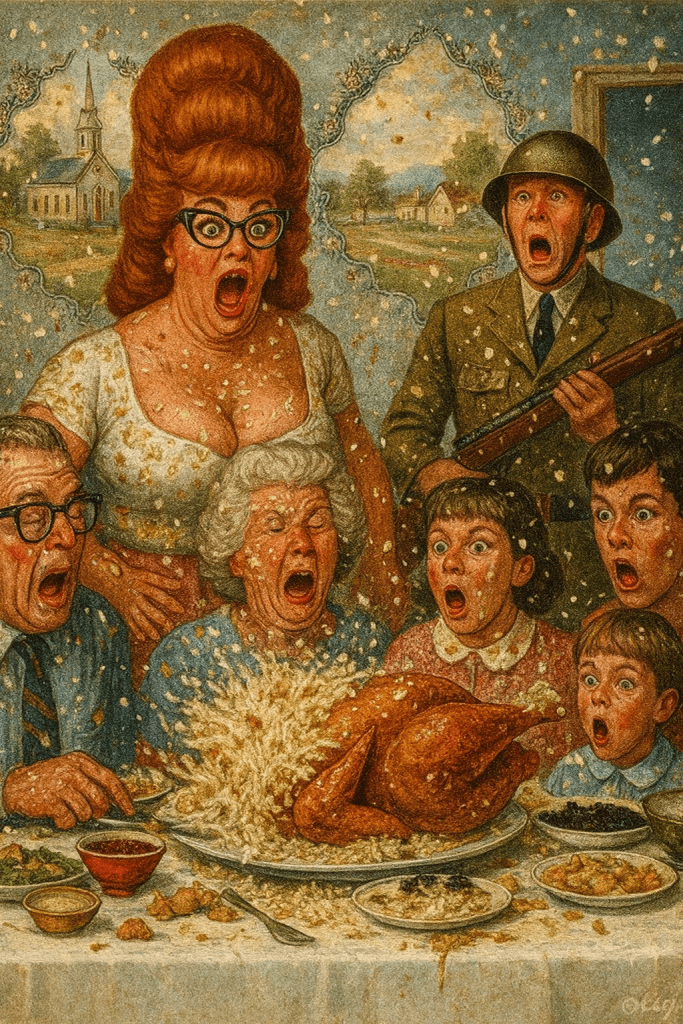
Mrs. Alden swept in with the turkey upon the white china platter of family heritage. It was flawless—golden brown, glistening, aromatic. A triumph.
Grandpa began grace.
“Let us bow our heads… Dear Lord, you have laid the table before us—”
KAAAA-BOOM.

A blast of Richter-scale proportions obliterated the table’s contents. The room vanished in a fog of wild rice, shallots, mushrooms, oysters—an edible Hiroshima.

Bits of turkey viscera clung to wallpaper where pastoral cattle once grazed. Oysters nestled in ox-drawn carts.

Everyone sat stunned—mouths agape, eyes fixed, silent as stone. An oyster dangled from the corner of Mrs. Alden’s glasses. A full pound of Cool Whip clung to her bouffant like a fallen glacier.

Slowly—like the Tin Man awakening with oil—fingers twitched, limbs moved, breath returned.

Then came Uncle Waldo.

His jaw clicked rhythmically; his eyes rolled back white as marshmallows; eyelids fluttered at hummingbird speed. A full neurological storm was underway.

His right arm shot up, hand planting on his bald skull like a radio antenna.

“Jap Zeros at six o’clock! They sank the Arizona!” he shouted.

He bolted from the table, donned his father’s WWI doughboy helmet, seized his M1917 Enfield rifle, and charged out the front door.

Our neighborhood watched in horror as Waldo aimed nearly straight upward.

“BANZAI, ROUND EYE!” came the cry.

“Banzai my ass!” he yelled, firing two .30-caliber rounds into the Indiana sky.

Mr. Bud Lutz, editor-in-chief of the Finn’s Landing Tribune, stood on his porch across the street—arms folded, expression grave.

“Everything under control, Marietta?” he called to my mother.

“Everything is fine,” I answered. “Uncle Waldo just repelled a Japanese airstrike.”

The Police Arrive

Officers Cary Dawalt and Sergeant Wheeler responded to reports of gunfire. My mother and grandfather explained Waldo’s war injury and history—omitting any reference to the turkey of mass destruction.

“And how did you all come to be covered in wild rice—and say—is that an oyster in your hair, Mrs. Henry?” Dawalt asked.

Mom removed it. “No… that’s a giblet.”

They decided not to press charges, especially after little Mark—squinting into the sun—proudly informed them:

“Why, them little yellow bastards!”

The officers wisely let the matter drop.

They confiscated the ammunition and bolt from Waldo’s rifle, rendering it harmless.

Aftermath

Miraculously, Grandma’s ham survived the blast. We ate it—wild-eyed and ravenous—while Grandpa began grace again, this time without interruption.

Mrs. Alden, brushing wild rice from her hair, resigned permanently and declared:

“You mad little monsters! That was the most beautiful turkey I ever cooked!”

In the following days, the incident never made the Finn’s Landing Tribune. Mr. Lutz, however, saluted Uncle Waldo each time they crossed porches—no doubt grateful to be alive.

And these were all things for which to be uniquely thankful regarding that Thanksgiving Day in 1968.
Https://BardOfTheWoods.com
https://Allplanhealthinsurance.com
Https://HealthandMedicareInsurance.com
Discover more from bardofthewoods.com
Subscribe to get the latest posts sent to your email.

Leave a comment